
High-Voltage Harness Project for New Energy Vehicles
Project Background
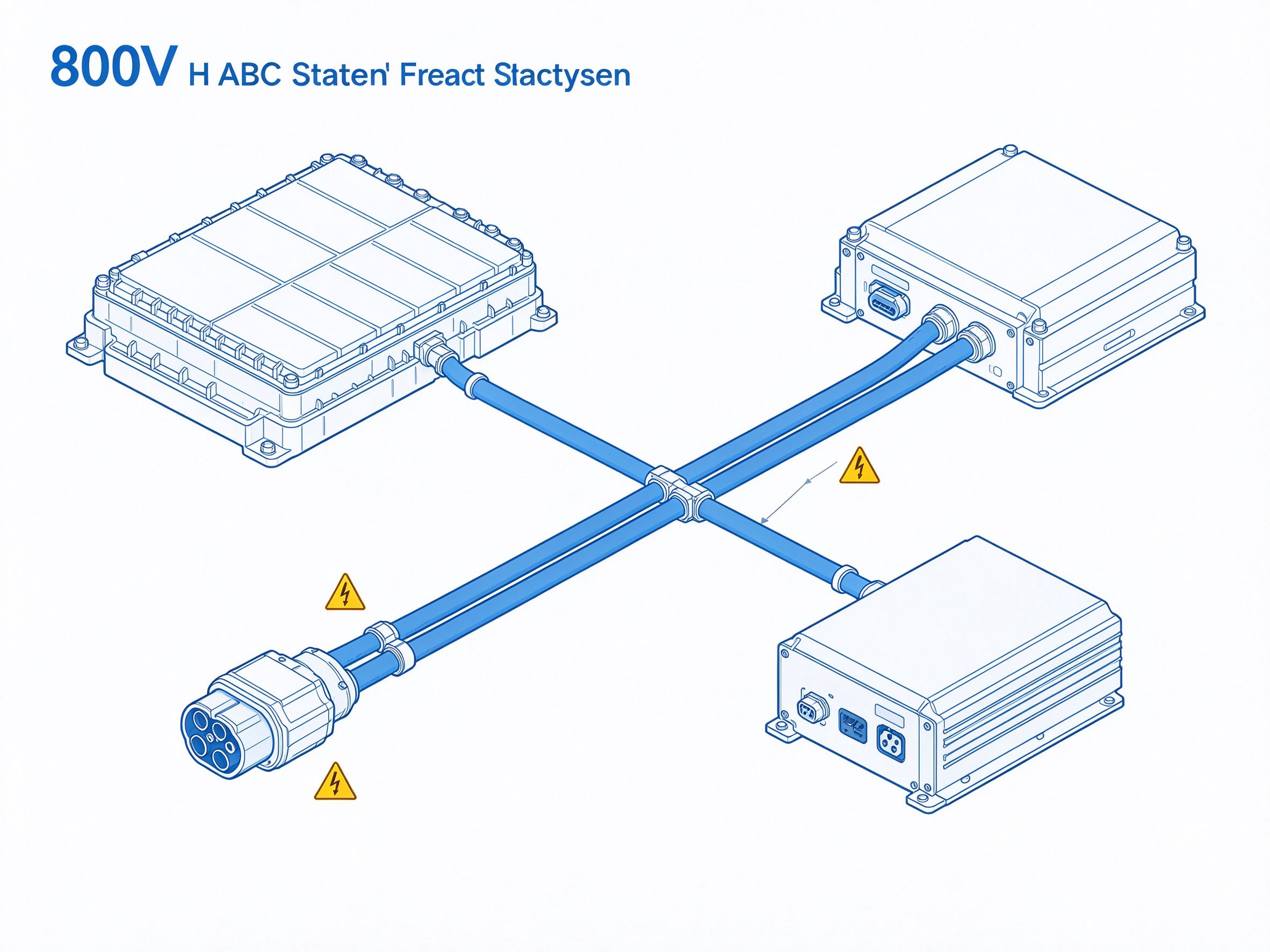
As new energy vehicle range and replenishment efficiency keep improving, high-voltage platform models are gradually becoming the market mainstream. High-voltage harnesses connect the battery pack, drive motor, charging system and high-voltage distribution unit, carrying the vehicle's energy transmission, and their insulation/voltage withstand, shielding and safety protection design directly concerns vehicle operating safety.
The high-voltage platform reduces working current by raising voltage, thereby cutting harness loss and weight and improving charging and electric-drive efficiency, but requirements on insulation materials, connection protection and shielding design also rise. High-voltage harnesses run across the battery pack, chassis and cabin, and any unreliable connection can affect vehicle safety, which is why vehicle makers audit high-voltage harness suppliers most strictly.
The customer of this project is a leading new energy vehicle enterprise, with product lines covering multiple high-voltage platform models; from project kickoff, we developed synchronously with the customer and completed sample validation and batch delivery on schedule.
High-voltage platform models clearly improve charging speed and range, driving an increase in vehicle high-voltage components, and the scale and complexity of high-voltage harness supply rise in step, requiring suppliers to have synchronous development and batch delivery capability across multiple models and harness types.
Customer Requirements
Provide a complete harness solution for the high-voltage platform of a leading new energy vehicle enterprise. The customer required products of high reliability and high safety meeting automotive-grade quality standards; at the same time, the supplier was required to have complete supply capability from design and development to batch delivery, with key process records traceable.
Solution and Design/Process Highlights
We formed a dedicated project team and completed development in 8 months from design and development to batch delivery. To meet the special requirements of the high-voltage platform, we selected XLPE cross-linked polyethylene high-voltage cables, adopted a dual shielding design of aluminum foil plus braiding, and integrated an HVIL high-voltage interlock loop to ensure product safety and reliability.
During synchronous development, the engineering team aligned milestones with the customer through the APQP process: carrying out FMEA risk identification, confirming high-voltage circuit protection, shielding continuity and interlock logic, and releasing BOM and drawings under control after sample freeze. At the sample stage, we cooperated with the customer on vehicle-end assembly validation, confirming that harness routing, fixation points and jacket protection meet chassis and battery pack layout requirements.
At the process level, high-voltage harness crimping parameters are controlled throughout: terminal crimp height, pull-out force and crimp status are confirmed individually, and shielding treatment and jacket protection are executed per drawing specifications; assembly implements first article inspection and in-process patrol inspection, and automatic cutting and crimping plus automatic continuity testing guarantee batch consistency.
Aiming at layout differences across vehicle platforms, the engineering team makes adaptation adjustments on a common design basis, keeping the material system and process methods consistent and shortening the development cycle for new platforms.
Product Range and Test Validation
The product range covers battery pack harnesses, motor controller harnesses, charging port harnesses, high-voltage junction box harnesses, DC-DC converter harnesses and other complete high-voltage system harnesses. All products pass 1000 V withstand voltage tests, insulation resistance tests, shielding effectiveness tests and other full-set high-voltage tests.
High-voltage tests are divided between the sample validation stage and the batch outgoing stage: at the sample stage, full-set high-voltage tests are completed to validate the design; at the batch stage, every harness is continuity tested and high-voltage test items are completed by batch. Shielding effectiveness tests validate electromagnetic compatibility between high-voltage circuits and nearby signal circuits, and insulation resistance tests confirm insulation status under long-term use. Incoming inspection, in-process check and outgoing final inspection are recorded at every stage; test records are archived by batch with terminal lot and serial number information, delivered with the goods to support incoming inspection and assembly validation at the vehicle end.
Project Results
The products passed the customer PPAP production part approval process on the first attempt, with stable batch delivery quality, zero quality complaints over two years and a 100 percent on-time delivery rate. Annual output now exceeds 100,000 sets, and we have become the customer's core high-voltage harness supplier.
Customer feedback: the harness products are stable and reliable, delivered on time, with professional technical support, making us a trustworthy partner.
During batch supply, we provide batch inspection records and traceability information as required, supporting the vehicle maker's incoming sampling and on-site technical support.
FAQ
Q: What higher requirements does the high-voltage platform place on harnesses?
A: The platform raises requirements on insulation/voltage withstand, shielding effectiveness and safety protection; harnesses must be specially designed per voltage platform and vehicle layout, and complete full-set high-voltage test validation at the sample stage before moving to batch.
Q: What are the features of XLPE cross-linked polyethylene high-voltage cables?
A: XLPE cross-linked polyethylene's insulation and heat resistance suit high-voltage energy transmission; combined with aluminum foil plus braiding dual shielding and HVIL interlock design, it ensures high-voltage connection safety.
Q: Which inspections do high-voltage harnesses undergo before shipment?
A: Every harness completes a continuity test, is checked against drawings for wire sequence, routing and labeling, and passes high-voltage test items such as withstand voltage, insulation resistance and shielding effectiveness; records are archived by batch for traceability.
Q: How is PPAP production part approval carried out?
A: Production part approval materials are submitted as required by the customer, including process records, inspection data and samples; after customer approval, production moves to mass production, and process control continues into mass production.
Contact Us
For inquiries about high-voltage harnesses, charging and energy storage harnesses or other automotive-grade harness solutions, please share your drawings or project information, and our engineering team will reply with a proposal and sampling plan after evaluation. Email sz136138@szfandouai.cn, phone 18929363263 (WhatsApp +86 18929363263). We are located at 7th Floor, Unit 2, Building E1-1, Qunyi Intelligent Manufacturing Industrial Park, No. 3 Xingyuan South Road, Start-up Area, China-Korea (Huizhou) Industrial Park, Zhongkai High-tech Zone, Huizhou.