
Industrial Robot Body Harness Project
Project Background
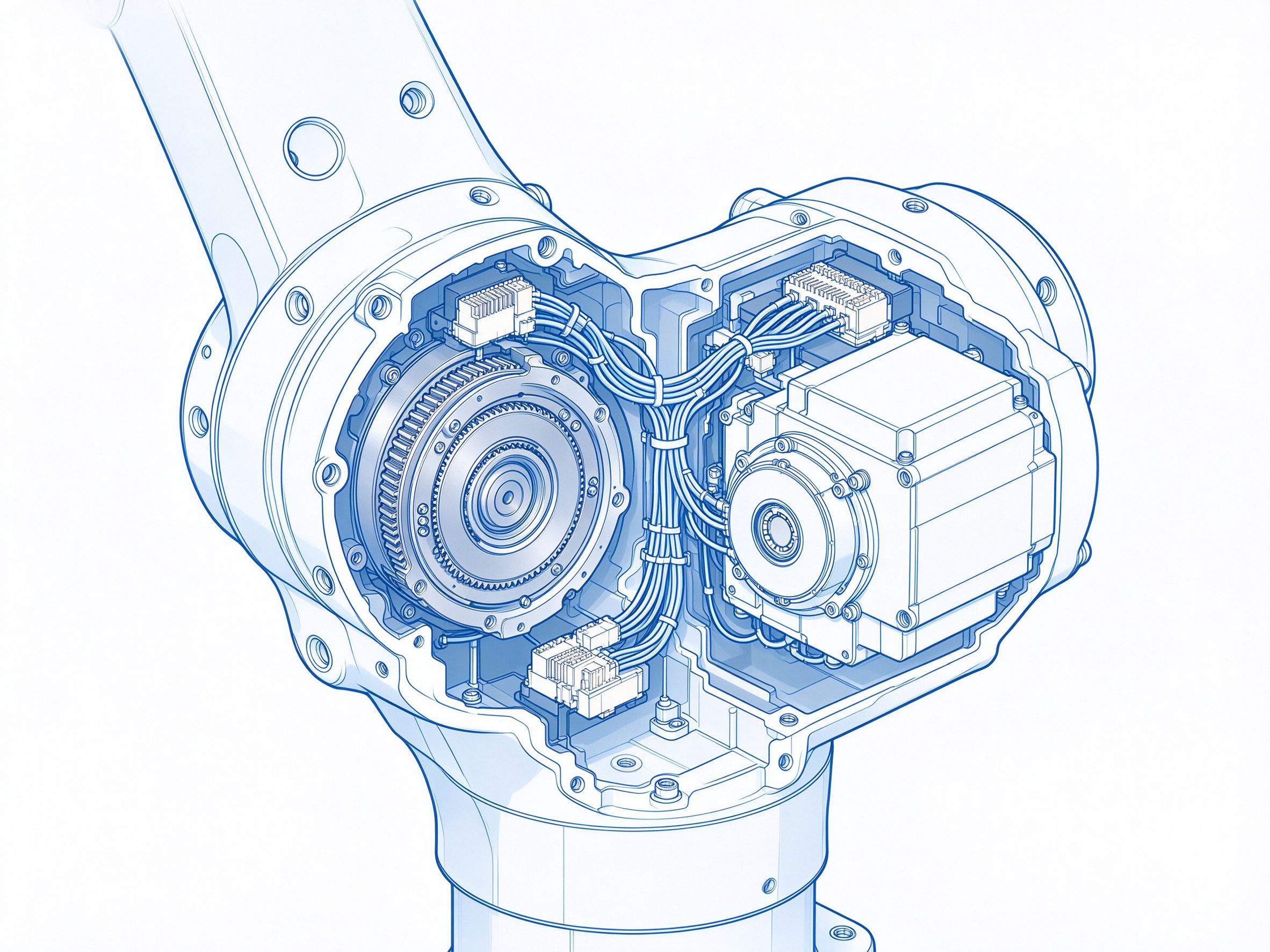
Industrial robots are the core equipment of intelligent manufacturing lines; during operation, six-axis robot joints keep rotating and bending, and the body interior simultaneously faces harsh conditions such as high temperature, vibration and oil, so the flexibility and reliability of supply harnesses directly determine the robot's service life and uptime. Robot harnesses must move repeatedly with joints while stably transmitting power and encoder signals, making them typical high-reliability motion harnesses.
As manufacturing automation rises, industrial robots are used more widely in automotive, electronics and logistics, and users demand higher continuous-operation capability. Internal joint space is narrow, and harnesses run together with encoder cables under complex motion conditions; once a harness fails prematurely, it directly affects line uptime and maintenance cost, so robot harness reliability validation runs through selection, design and batch. Between body and control cabinet there are also multiple signals such as power and encoder, and the harness must carry them together within the narrow space without mutual interference, imposing high requirements on branch design and routing planning.
The customer of this project is an industrial robot enterprise whose products cover the full series of six-axis robots, needing the complete set of body harnesses and control cabinet harnesses. Early in the project, we carried out harness selection and routing design review targeting robot joint motion characteristics.
Customer Requirements
Supply the complete set of body harnesses and control cabinet harnesses for an industrial robot enterprise's six-axis robot products. The customer required products to be ultra-flexible, adapting to frequent robot joint motion.
Solution and Design/Process Highlights
Aiming at the harsh internal conditions of high temperature, vibration and bending, we selected PUR high-flexibility drag-chain cables and high-reliability connectors, ensuring products work reliably over the robot's life. For joint motion needs, harness design considers twist and bend margins to avoid damage during long-term motion.
In routing design, body harnesses reserve twist and bend margins along the joint rotation axis, avoiding extra conductor tension at motion limits; drag-chain cable bending radius and routing are arranged per the robot's motion envelope, reducing fatigue damage from local repeated bending. Control cabinet harnesses focus on neat routing and fixed labeling, making on-site assembly and later maintenance easy.
At the process level, flexible harness crimping and assembly follow controlled processes: incoming inspection checks wire spec and flexibility grade, crimp parameters and terminal crimp status are confirmed one by one, and assembly reserves twist and bend margins along the robot body routing, with special tooling fixing branch positions. Before shipment, every harness completes a continuity test and visual check, and batch and terminal-lot records are archived with the product for traceability.
The project advances through the APQP process: at the solution stage, cross-department review identifies potential failure modes under motion, vibration and other conditions and forms FMEA records; design changes enter batch preparation only after review, ensuring the solution confirmed by the customer at each node matches the final mass-production state.
Product Range and Test Validation
The product range covers robot body harnesses, control cabinet harnesses, encoder harnesses, power harnesses and the complete set of robot harnesses. All products pass 50 million-cycle bending tests, 1,000-hour vibration tests, oil-resistance tests and other reliability test items.
At incoming, PUR wire bend-resistance grade and jacket appearance are checked, and terminal pull-out force and continuity are confirmed after crimping; dynamic bending and vibration tests run continuously on dedicated equipment, and a batch can be released only after samples pass. Reliability tests cover typical conditions such as dynamic bending, vibration and oil resistance, simulating the robot's long-term operating environment; test samples and batch products follow the same process and inspection standards, ensuring validation results are reusable for batch delivery.
Project Results
The products passed the customer's strict reliability tests, with stable batch delivery quality and zero quality complaints over three years. The products are applied across the customer's full series of six-axis robots, with annual supply exceeding 200,000 sets, earning high customer recognition.
Customer feedback: the harnesses are flexible and highly reliable, performing very stably on our robot products; you are a professional harness supplier.
FAQ
Q: Why do robot body harnesses require ultra-high flexibility?
A: Robot joints keep rotating and bending during operation; ordinary harnesses easily suffer core-wire breakage and contact failure after repeated bending, while high-flexibility wires adapt to long-term dynamic motion.
Q: Where are PUR high-flexibility drag-chain cables suitable?
A: They suit dynamic occasions such as body harnesses that move with joints and drag-chain follow routing; specific selection is assessed by motion amplitude, bending frequency and environmental media.
Q: How do body harnesses and control cabinet harnesses differ in design?
A: Body harnesses move dynamically with joints and emphasize flexibility and margin design; control cabinet harnesses are mainly fixed routing and emphasize neat routing, wire-sequence labeling and assembly convenience.
Q: How are encoder signals and power harnesses arranged?
A: Signal branches and power branches are routed in zones along machine routing to reduce mutual interference; shielding and branch design are executed per drawing specifications, and signal and continuity validation are completed before shipment.
Q: Which items are included in robot harness reliability testing?
A: Reliability items such as bending, vibration and oil resistance are executed as required by the customer, simulating typical robot operating conditions; test samples and batch products follow the same process standards.
Contact Us
For inquiries about industrial robot harnesses, high-flexibility drag-chain harnesses or control cabinet harness solutions, please share your drawings or samples, and our engineering team will reply with a proposal and sampling plan after evaluation. Company address: 7th Floor, Unit 2, Building E1-1, Qunyi Intelligent Manufacturing Industrial Park, No. 3 Xingyuan South Road, Start-up Area, China-Korea (Huizhou) Industrial Park, Zhongkai High-tech Zone, Huizhou; email sz136138@szfandouai.cn, phone 18929363263.