
Industrial Robot Harness Project for an Industrial Robot Manufacturer
Project Background
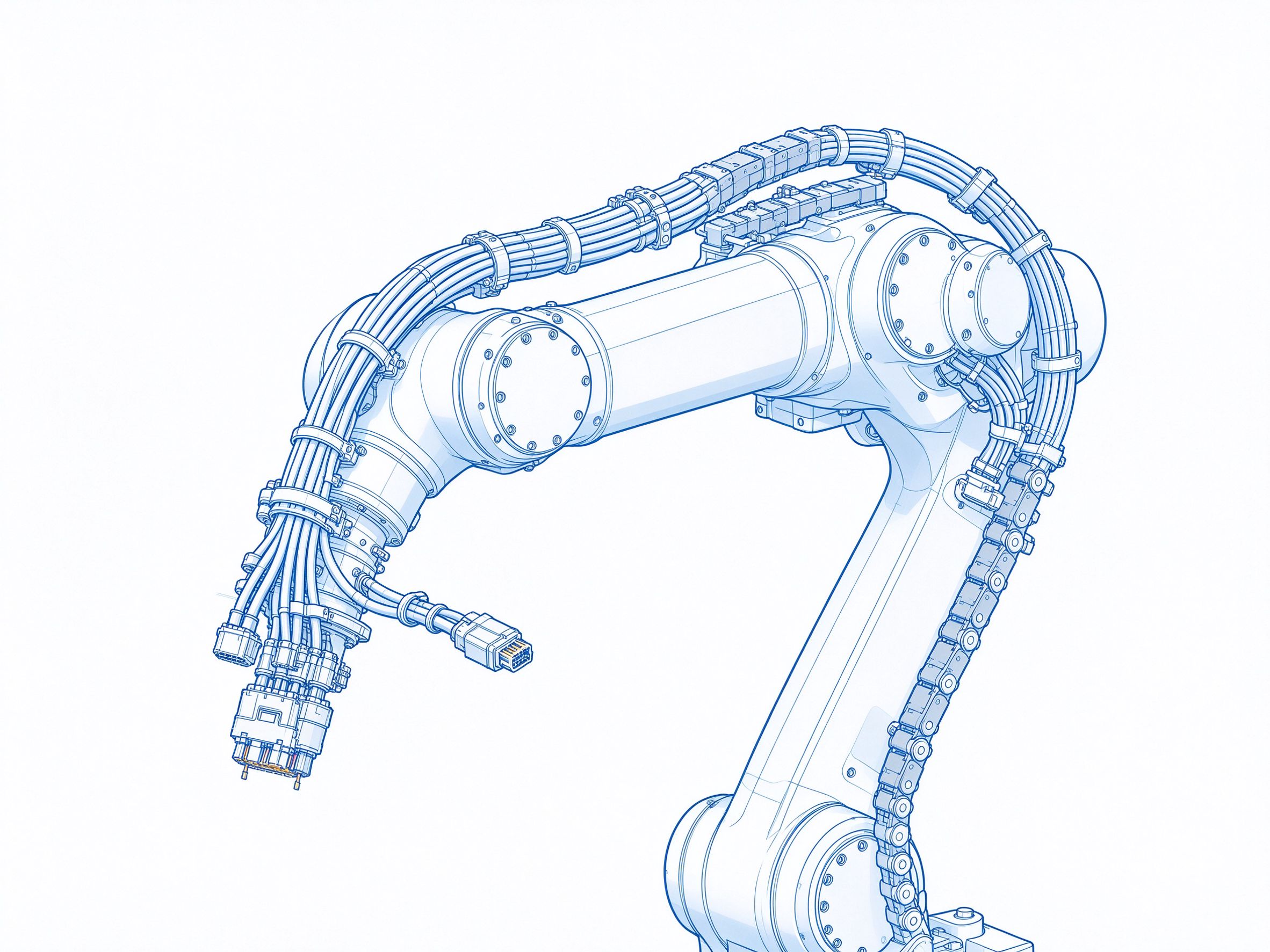
As manufacturing automation upgrades, industrial robots are used increasingly widely in welding, handling, assembly and palletizing stations. The joints of a six-axis robot rotate and twist repeatedly during operation, and the body harness moves synchronously with the joints, making it one of the components with the harshest internal conditions; once the harness breaks from bending fatigue, it directly stops the machine, so robot customers demand extremely high flexibility and reliability.
On automated lines, robots often work continuously for long hours, and the internal body harness reciprocates with joints day after day; common failure modes include conductor strand breakage, jacket cracking and terminal contact failure. For machine makers, harness reliability directly determines equipment failure-free operation, so robot projects must pass harsh motion and environmental validation at the sample stage.
In recent years, domestic industrial robots have developed rapidly and machine platforms keep expanding, raising requirements on harness suppliers' fast response and full-range supply capability; the harness, as an internal component with many types and dense quantities, also has a sound design that directly affects machine assembly efficiency.
The customer of this project is an industrial robot enterprise, and we supply the complete set of body harnesses and control cabinet harnesses for its six-axis robot products.
Customer Requirements
Supply the complete set of body harnesses and control cabinet harnesses for an industrial robot enterprise's six-axis robot products. The customer required products to be ultra-flexible, adapting to frequent robot joint motion.
The customer also required the harness to match the robot's design life: no cracking or wire breakage under long-term high-frequency motion, resistance to high temperature, vibration and oil environments, and reliable mating with the control-cabinet side, so the machine maker can insert quickly on the line.
Solution and Design/Process Highlights
Aiming at the harsh internal conditions of high temperature, vibration and bending, we selected PUR high-flexibility drag-chain cables and high-reliability connectors, ensuring products work reliably over the robot's life. For joint motion needs, harness design considers twist and bend margins to avoid damage during long-term motion.
PUR high-flexibility drag-chain cables use multi-strand fine-lay conductors and a flexible jacket, maintaining conductor continuity under repeated bending; joint exit points are routed at the natural bending radius with reserved twist margins, so the harness stays stress-relaxed as it follows joint motion, avoiding sharp kinks and pulling. Control-cabinet harnesses are arranged with strong and weak currents separated, organized neatly with cable trays and fixings for easy in-cabinet maintenance.
In process, parameters such as crimp height and pull-out force are confirmed at first article and then produced under control; automatic cutting and crimping plus automatic continuity testing improve batch consistency; in-process patrol inspection is executed per work instructions, and terminal lots are cross-referenced one-to-one with product serial numbers, supporting later quality traceability.
During cooperation, our engineering team holds regular alignment with the customer's technical team, synchronously updating harness routing and material selection as joint layouts change for new models, keeping the harness solution in step with robot platform iteration.
Product Range and Test Validation
The product range covers robot body harnesses, control cabinet harnesses, encoder harnesses, power harnesses and the complete set of robot harnesses. All products pass 50 million-cycle bending tests, 1,000-hour vibration tests, oil-resistance tests and other reliability test items.
The bending test simulates joint reciprocating motion, the vibration test simulates mechanical excitation during machine operation, and the oil-resistance test simulates workshop cutting fluid and oil environments; only after reliability tests pass can products support the customer's machine validation and move to batch. Outgoing inspection completes a continuity test on every harness and checks wire sequence and jacket assembly status; test reports and batch information are delivered with the goods, supporting incoming inspection and reliability retesting at the customer's machine end.
Project Results
The products passed the customer's strict reliability tests, with stable batch delivery quality and zero quality complaints over three years. The products are applied across the customer's full series of six-axis robots, with annual supply exceeding 200,000 sets, earning high customer recognition.
Customer feedback: the harnesses are flexible and highly reliable, performing very stably on our robot products; you are a professional harness supplier.
During batch supply, we provide batch inspection records and traceability information as required, supporting the customer's machine-end quality spot checks and on-site technical service.
FAQ
Q: Why are robot body harnesses so demanding on flexibility?
A: Six-axis robot joints rotate and twist repeatedly during work, and the harness moves synchronously with them; materials and structure must withstand high-frequency bending and twisting, otherwise conductor breakage or jacket cracking easily occurs.
Q: Which conditions suit PUR high-flexibility drag-chain cables?
A: The PUR jacket is flexible, oil-resistant and bend-resistant, suiting follow-along, drag-chain and joint reciprocating occasions; combined with reserved bend and twist margins, it improves harness reliability over the robot's life.
Q: How do body harnesses and control cabinet harnesses differ in design?
A: Body harnesses move with joints and emphasize flexibility, bend resistance and twist margins; control cabinet harnesses are relatively fixed and emphasize reliable connection, vibration resistance and neat in-cabinet routing.
Q: How is robot harness reliability validated?
A: Before batch, reliability items such as bending, vibration and oil resistance are completed per operating conditions, and production moves to batch only after passing; before shipment, every harness undergoes continuity testing and batch records are retained.
Q: How do you cooperate on new-model development?
A: After the customer provides model structure or motion-range information, the engineering team evaluates harness routing and material solutions, and samples and validation nodes advance per the project plan and customer confirmation.
Contact Us
For inquiries about industrial robot body harnesses, control cabinet harnesses or other high-flexibility harness solutions, please share your model structure or drawings, and our engineering team will reply with a proposal and sampling plan after evaluation. Email sz136138@szfandouai.cn, phone 18929363263 (WhatsApp +86 18929363263). We are located at 7th Floor, Unit 2, Building E1-1, Qunyi Intelligent Manufacturing Industrial Park, No. 3 Xingyuan South Road, Start-up Area, China-Korea (Huizhou) Industrial Park, Zhongkai High-tech Zone, Huizhou.