
Patient Monitor Harness Project for a Medical Equipment Manufacturer
Project Background
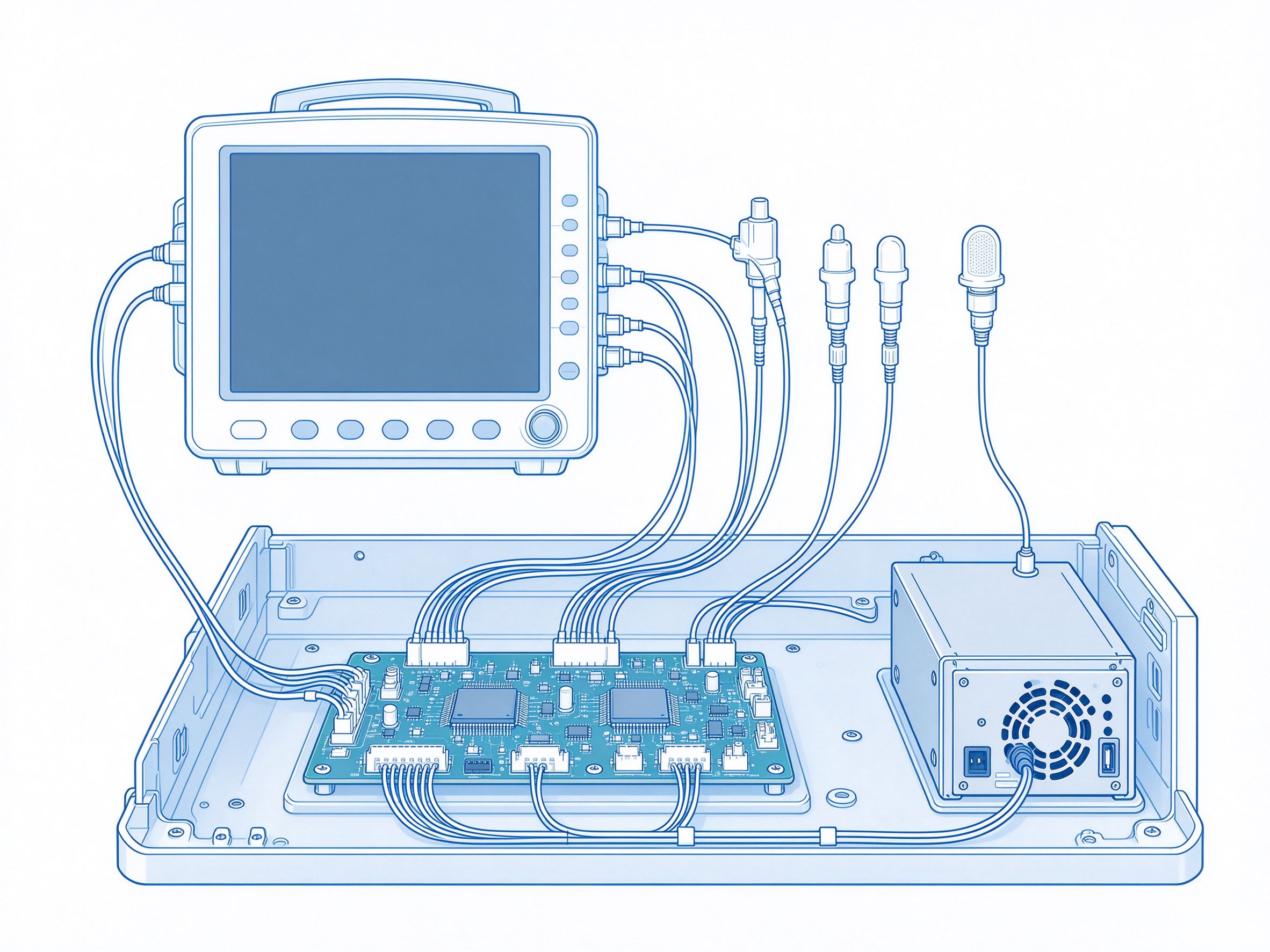
A multi-parameter patient monitor is the core monitoring device in ward and emergency scenarios, collecting physiological signals such as ECG, SpO2, blood pressure and body temperature in real time; its internal harness carries the dual tasks of power distribution and weak physiological signal transmission. Monitor signals are very small in amplitude, and any external interference may affect waveform and reading accuracy; at the same time, electrical safety directly concerns the personal safety of patients and medical staff, and the industry has strict requirements on safety design and testing of medical electrical equipment.
Multi-parameter monitors need to work continuously for long hours, and harness connection stability directly affects the continuity of monitoring data. Medical equipment imposes strict requirements on internal component consistency and traceability, which requires the harness supplier to keep materials, process and inspection under controlled conditions, ensuring batch products match the confirmed sample.
The customer of this project is a medical device enterprise, and we supply internal harnesses for its multi-parameter monitors.
Monitor usage covers wards, emergency and transport, so the device must withstand different ambient temperatures and daily cleaning and disinfection; internal harnesses stay powered on long term, demanding very high long-term reliability and consistency.
Customer Requirements
Supply internal harnesses for a medical device enterprise's multi-parameter monitors. The customer required products to meet medical device safety standards, with high reliability and safety.
The customer also required the harness to fit the monitor's compact internal layout: completing connections among power module, acquisition board and sensors within limited space, suppressing interference on signal branches to ensure high-precision acquisition, and supporting stable batch supply.
Solution and Design/Process Highlights
We design and produce strictly according to medical electrical equipment safety standards, using medical-grade wires and connectors to ensure electrical safety and biocompatibility. Targeting the monitor's high-precision signal acquisition needs, we select wires with excellent shielding performance to effectively suppress interference signals.
In routing design, power circuits and acquisition circuits run separately, and shielding layers are uniformly grounded per drawings to avoid cross-circuit crosstalk; sensor connector cables use fine, flexible wires for easy threading inside the monitor's compact shell; connectors carry locking structures to prevent loosening during transport and use. Harness routing avoids heat-dissipating parts and moving areas such as buttons, and fixation is designed per shell structure to avoid wear and displacement in long-term use.
In production, the harness follows whole-process control of incoming inspection, in-process check and outgoing inspection: wires and connectors first undergo incoming inspection, crimping and assembly are checked by patrol frequency, and finished products complete per-piece continuity testing; batch records and inspection reports are archived, supporting the customer's registration inspection and later quality traceability.
At the sample stage, the engineering team runs joint functional testing of the harness sample together with the complete monitor, confirming signal acquisition waveforms and power stability before freezing the solution, reducing later design changes.
Product Range and Test Validation
The product range covers power harnesses, signal acquisition harnesses, sensor connector cables and the complete set of monitor internal harnesses. All products pass withstand voltage tests, leakage current tests, insulation resistance tests and other medical safety test items, as well as biocompatibility tests.
Withstand voltage, leakage current and insulation resistance tests validate the harness's electrical safety boundary at the component level; biocompatibility tests set requirements on materials that may contact patients. Outgoing inspection is executed per medical product record requirements, and inspection data and batch information are archived to meet the customer's quality system audit and product traceability needs. Before shipment, each harness is checked for wire sequence, routing and labeling, and completes continuity and connection-reliability checks; test records are delivered with the batch, supporting assembly and validation at the customer's machine end.
Project Results
The products passed medical device registration inspection, with 5 years of batch delivery and zero quality complaints. The products are applied across the customer's full series of multi-parameter monitors and exported to many countries and regions worldwide, earning high recognition from customers and end users.
Customer feedback: the harness products are reliable and meet medical device safety requirements; cooperation has been stable for years, and you are a trustworthy supplier.
During cooperation, we supported the customer in harness upgrades across multiple platform generations, adjusting branches and routing to new model structures, and maintaining batch delivery consistency and complete traceability records.
FAQ
Q: Why do monitor harnesses emphasize shielding so much?
A: The physiological signals collected by monitors are very weak, and power and external electromagnetic interference easily couple into acquisition circuits; shielded wires and proper grounding can effectively suppress interference and ensure acquisition accuracy.
Q: Which safety tests must medical harnesses pass?
A: Designed and produced per medical electrical equipment safety requirements, products pass withstand voltage, leakage current, insulation resistance and other medical safety test items, as well as biocompatibility tests.
Q: How do medical-grade wires and connectors differ from ordinary harnesses?
A: Medical scenarios demand higher electrical safety and material requirements; medical-grade wires and connectors are more suitable for medical equipment interiors in insulation, electrical safety and biocompatibility.
Q: How is cooperation arranged from sampling to batch supply for medical projects?
A: After the customer provides the monitor structure and circuit requirements, the engineering team evaluates shielding and safety design; sample validation advances in step with registration inspection, and production moves to batch after confirmation.
Contact Us
For inquiries about monitor medical harnesses, internal device connecting cables or other medical supply harness solutions, please share your drawings or device structure information, and our engineering team will reply with a proposal and sampling plan after evaluation. Email sz136138@szfandouai.cn, phone 18929363263 (WhatsApp +86 18929363263). We are located at 7th Floor, Unit 2, Building E1-1, Qunyi Intelligent Manufacturing Industrial Park, No. 3 Xingyuan South Road, Start-up Area, China-Korea (Huizhou) Industrial Park, Zhongkai High-tech Zone, Huizhou.