
Multi-Parameter Patient Monitor Medical Harness Project
Project Background
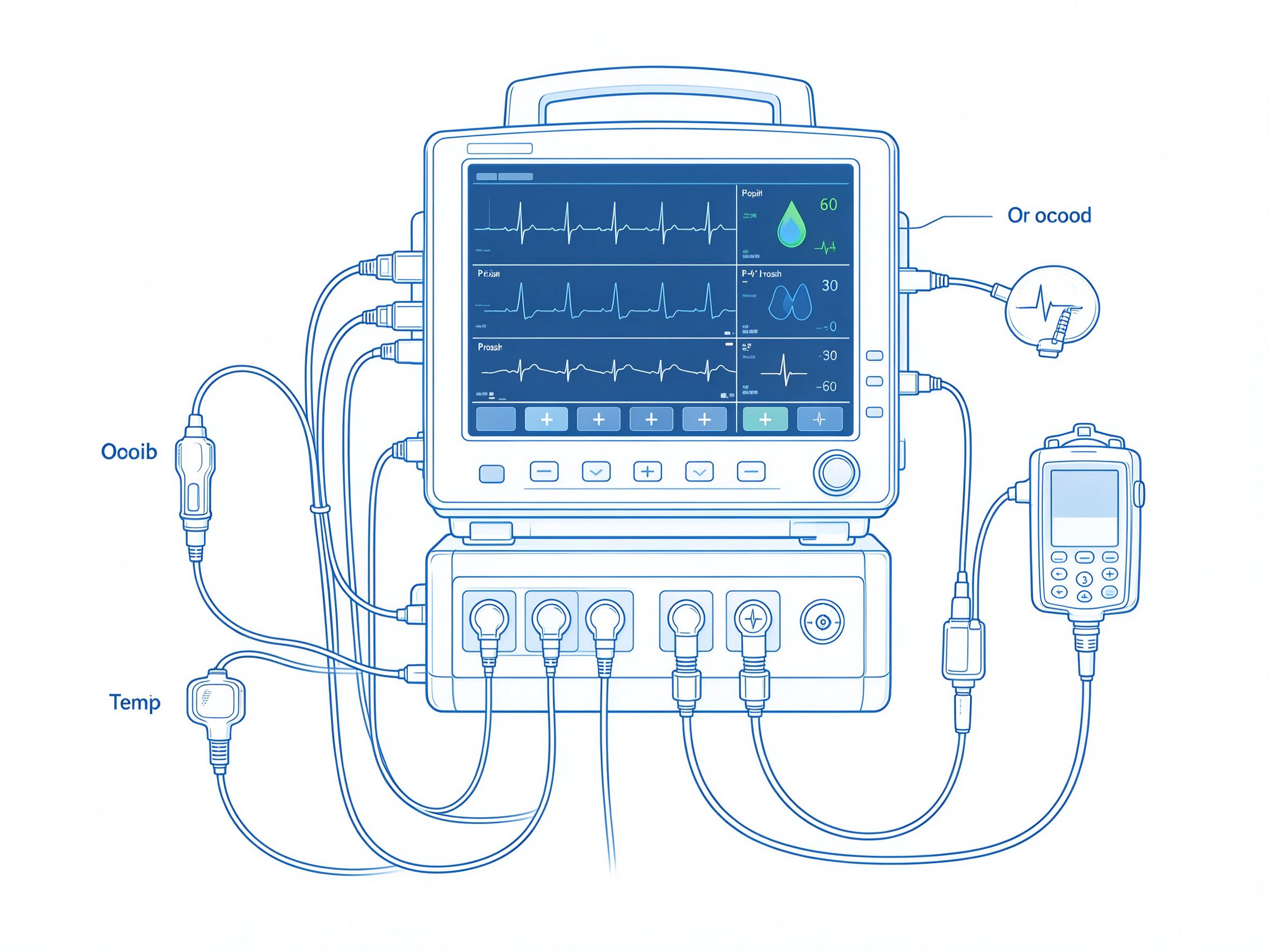
Multi-parameter monitors continuously monitor patient vital signs such as ECG, blood pressure and SpO2 in ward and monitoring scenarios; the device contacts patients and the medical environment for long hours, so the electrical safety and biocompatibility of its internal harnesses are an important part of medical device safety. Monitors also require acquisition of weak physiological signals, and harness shielding design directly affects signal quality and monitoring accuracy.
Monitoring equipment must run continuously for long hours, and every fluctuation in patient status relies on stable transmission by the acquisition chain; the harness, as the carrier of power and signals, has crimping reliability and insulation performance that cannot be neglected. Over the product life cycle, monitoring equipment is repaired and replaced infrequently, and harnesses run maintenance-free over the machine's service life, so reliability itself is a design goal. Meanwhile, monitor product lines often derive multiple configurations on the same platform for export to different markets, imposing high requirements on the supplier's process consistency and traceability.
The customer of this project is a medical device enterprise whose product line covers the full series of multi-parameter monitors exported to many countries and regions, needing internal harness supply that meets medical device safety requirements. Early in the project, we established dedicated production and inspection processes per medical product quality requirements.
Customer Requirements
Supply internal harnesses for a medical device enterprise's multi-parameter monitors. The customer required products to meet medical device safety standards, with high reliability and safety.
Solution and Design/Process Highlights
We design and produce strictly according to medical electrical equipment safety standards, using medical-grade wires and connectors to ensure electrical safety and biocompatibility. Targeting the monitor's high-precision signal acquisition needs, we select wires with excellent shielding performance to effectively suppress interference signals.
In production organization, medical harnesses are zoned and managed separately from other product lines; work instructions, inspection specifications and batch records are executed as controlled documents; operators at key stations are trained before taking up their posts, and crimping parameters, continuity and safety test results are recorded batch by batch. Such process control meets the customer's internal quality audit requirements and also provides traceable data for product registration changes.
In process control, medical harness production takes place in a controlled environment: incoming inspection checks medical-grade wire and connector specs, crimping and assembly follow work instructions with process records retained, and finished products complete per-piece continuity and safety tests before shipment. Production batch, terminal lot and serial number are archived one-to-one, supporting the traceability needs of medical device registration and quality system audits.
The project advances through the APQP process: at the solution stage, review identifies key process control points, and key material and process changes are implemented only after customer confirmation; inspection specifications and batch records are jointly confirmed with the customer early in the project, serving as the release basis for later batch delivery.
Product Range and Test Validation
The product range covers power harnesses, signal acquisition harnesses, sensor connecting cables and the complete set of monitor internal harnesses. All products pass withstand voltage tests, leakage current tests, insulation resistance tests and other medical safety test items, as well as biocompatibility tests.
At incoming, medical-grade wire and connector spec certificates and appearance are checked, and key crimping stations are confirmed individually; shielding treatment of signal acquisition branches is executed per drawings, and after assembly every harness is continuity checked. In routing zoning, weak-signal circuits and power circuits are arranged separately along routing, reducing coupling interference from power circuits to acquisition signals inside the machine. Each batch is released only after completing tests per the customer-confirmed inspection specification, and test records are saved by batch; when customer registration inspection or quality audit needs traceability, corresponding production and inspection records can be pulled by batch number.
Project Results
The products passed medical device registration inspection, with 5 years of batch delivery and zero quality complaints. The products are applied across the customer's full series of multi-parameter monitors and exported to many countries and regions worldwide, earning high recognition from customers and end users.
Customer feedback: the harness products are reliable and meet medical device safety requirements; cooperation has been stable for years, and you are a trustworthy supplier.
FAQ
Q: What safety design requirements apply to internal harnesses of medical devices?
A: Medical harnesses must be designed and produced strictly per medical electrical equipment safety standards, pass medical safety test items such as withstand voltage, leakage current and insulation resistance, and meet biocompatibility requirements.
Q: Why does high-precision monitor signal acquisition need shielded harnesses?
A: Physiological signals are weak and easily disturbed by the environment; wires with excellent shielding performance can effectively suppress interference signals and ensure acquisition accuracy.
Q: What does biocompatibility of internal monitor harnesses mean?
A: It means materials at patient-contact parts must meet biocompatibility requirements to avoid irritation and adverse reactions, and related validation is executed per confirmed test items.
Q: How do medical projects support registration inspection and quality audits?
A: Products are released after completing tests per the confirmed inspection specification; production batch, terminal lot and serial number are archived one-to-one, and traceability records can be provided by batch number to support registration and audits.
Q: What is the sampling process for medical harness projects?
A: The engineering team evaluates structural and process feasibility based on drawings or samples and replies with a proposal and sampling plan; the specific schedule is confirmed with the customer's engineering team.
Contact Us
For inquiries about monitor harnesses, internal medical device harnesses or other medical-grade harness solutions, please share your drawings or samples, and our engineering team will reply with a proposal and sampling plan after evaluation. Company address: 7th Floor, Unit 2, Building E1-1, Qunyi Intelligent Manufacturing Industrial Park, No. 3 Xingyuan South Road, Start-up Area, China-Korea (Huizhou) Industrial Park, Zhongkai High-tech Zone, Huizhou; email sz136138@szfandouai.cn, phone 18929363263.