
Crimping Process and Quality Control for Wire Harnesses
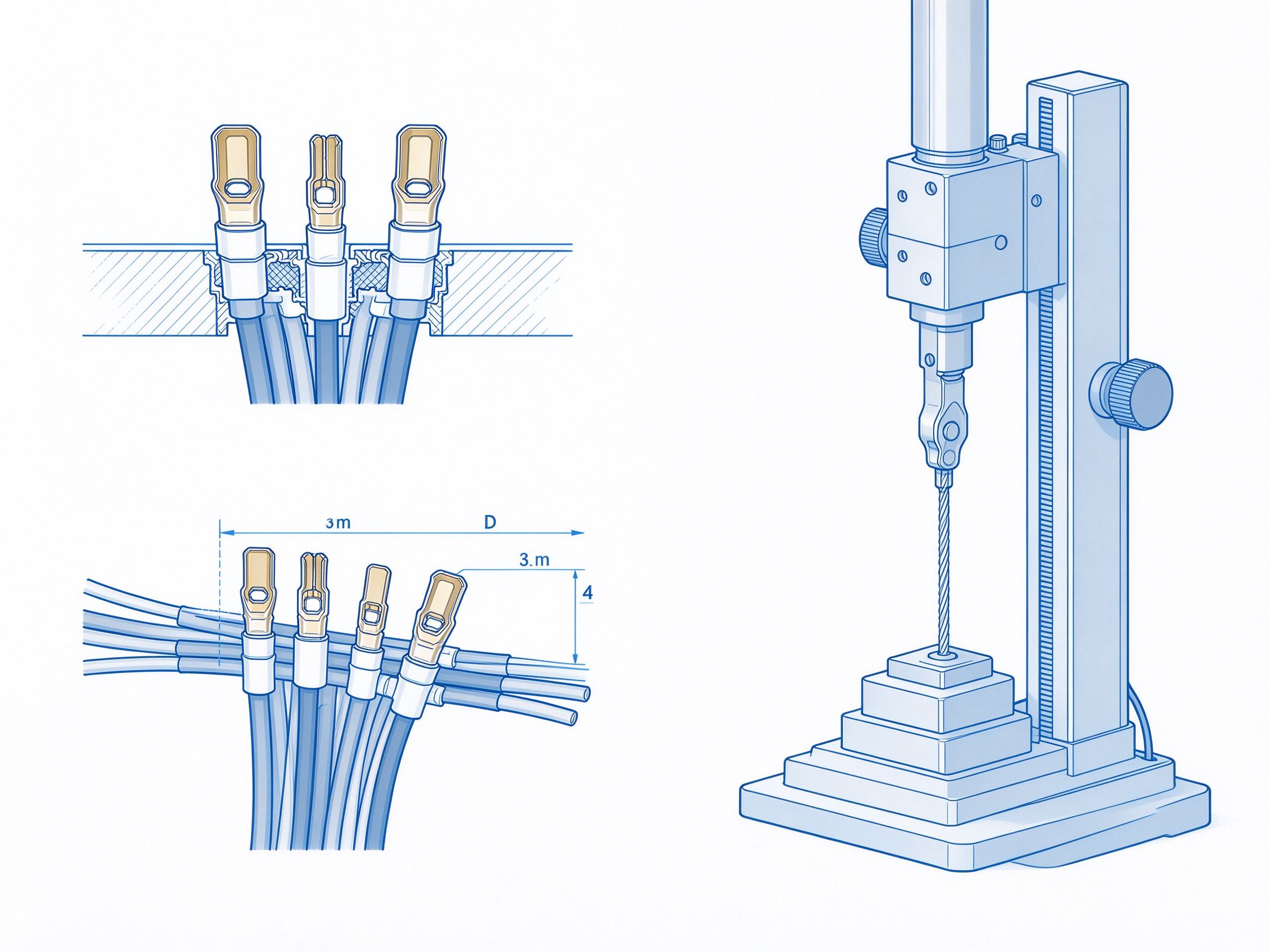
Crimping is one of the most critical processes in wire harness production, and crimp quality directly affects the electrical performance and mechanical strength of the harness. Statistics show that about 70% of harness failures are related to poor crimping. This article details crimping process parameters and quality control methods.
I. Basic Principle of Crimping
Crimping is a process that uses a crimping tool to join a terminal and a wire through plastic deformation. A good crimp should meet all of the following requirements:
1. Electrical performance: low and stable contact resistance.
2. Mechanical performance: sufficient pull-out force so that the joint does not detach.
3. Stress relief: the crimp point provides good stress relief to avoid wire fatigue fracture.
II. Key Process Parameters
1. Crimp height: the most important parameter affecting crimp quality; it must be adjusted strictly according to the terminal specification. The general tolerance is controlled within +/-0.02mm.
2. Crimp width: affects the mechanical strength and contact area of the crimp.
3. Stripping length: must be accurate; too long leaves too much exposed copper, while too short pushes insulation into the crimp zone.
4. Terminal position: the terminal must be centered on the crimp blade; offset causes poor crimping.
III. Quality Control Methods
1. Pull-out force test: the first piece of each batch must undergo a pull-out force test to ensure it meets the standard.
2. Cross-section analysis: periodically slice and analyze the crimp cross-section to observe the copper filling. The ideal filling rate should be above 90%.
3. Resistance test: measure the contact resistance at the crimp point to ensure it is within the qualified range.
4. Visual inspection: check the crimp for burrs, stray strands, broken wires and other defects.
IV. Common Crimp Defects
1. Over-crimping: crimp height too small, causing copper or terminal fracture.
2. Under-crimping: crimp height too large, causing high contact resistance and insufficient pull-out force.
3. Misalignment: the terminal is offset, resulting in incomplete crimping on one side.
4. Stray strands: copper wires protruding from the crimp, which may cause a short circuit.
Our company uses fully automatic crimping machines equipped with a pressure monitoring system that monitors crimp quality in real time, ensuring that every harness meets the quality standards.