
Conference Flat Panel Commercial Display Harness Project
Project Background
As the core terminal for smart office and remote collaboration, the conference flat panel integrates high-definition display, multi-touch and audio-video conferencing; its compact internal space poses dual challenges for harness thickness, integration and signal quality. Commercial display devices update quickly in large volumes, so harness suppliers must not only support structural design with thin solutions, but also keep wire sequence, length and signal performance consistent in high-volume delivery.
In recent years, demand for smart office and remote collaboration has kept growing, and conference flat panels are evolving toward large size, narrow bezels and ultra-thin bodies; the density of display drivers, touch units and audio-video modules keeps rising, and space left for harnesses is further compressed. Thin design and high integration have become the core proposition of commercial display harness design, and suppliers must engage at the structural design stage, weighing routing, connector positions and assembly process together with the machine team.
The customer of this project is a well-known domestic commercial display company whose conference flat panel product line covers multiple sizes and configurations, needing harness supply that supports the whole journey from design and development to batch delivery. We engaged in structural review early in the project, jointly determining the thin harness solution and inspection standards with the customer.
Customer Requirements
The customer is a well-known domestic commercial display company whose conference flat panels impose dual requirements on internal wiring: on one hand, the machine pursues slimness, so the harness must be thin and occupy little space; on the other hand, high-definition display and touch functions demand very high signal integrity and batch consistency. The customer needed a harness supplier that can support the whole journey from design and development to batch delivery.
Solution and Design/Process Highlights
We developed a thin harness solution for the conference flat panel structure: FFC flat cables carry display signals and ultra-fine coaxial cables carry high-frequency signals, compressing harness thickness while ensuring signal quality. Multiple circuits are integrated into neat branches along machine routing, reducing connectors and insertion points; signal branches are shielded, and wire sequence, routing and length are fixed one by one per drawings, ensuring consistency in high-volume production.
In branch design, once display signal branches use FFC flat cables, conductor arrangement changes from a 3D bundle to a flat structure, markedly reducing harness thickness; high-frequency branches maintain impedance continuity by controlling the bending radius and crimping process of coaxial cables. After multi-branch bundling, machine insertion points decrease, and the risk of loose insertion on the customer's line drops in step.
In process control, we execute the universal three-stage harness gate of incoming inspection, in-process inspection of crimping and assembly, and outgoing final inspection: wires and connectors are checked against specifications and for appearance before storage; key parameters such as crimp height and terminal pull-out force are confirmed one by one per work instructions; after assembly, wire sequence and routing are rechecked against drawings. Production uses automatic cutting and crimping and automatic continuity testing equipment, reducing manual variation; every batch retains batch and terminal-lot traceability records, supporting the customer's incoming validation.
Product Range and Test Validation
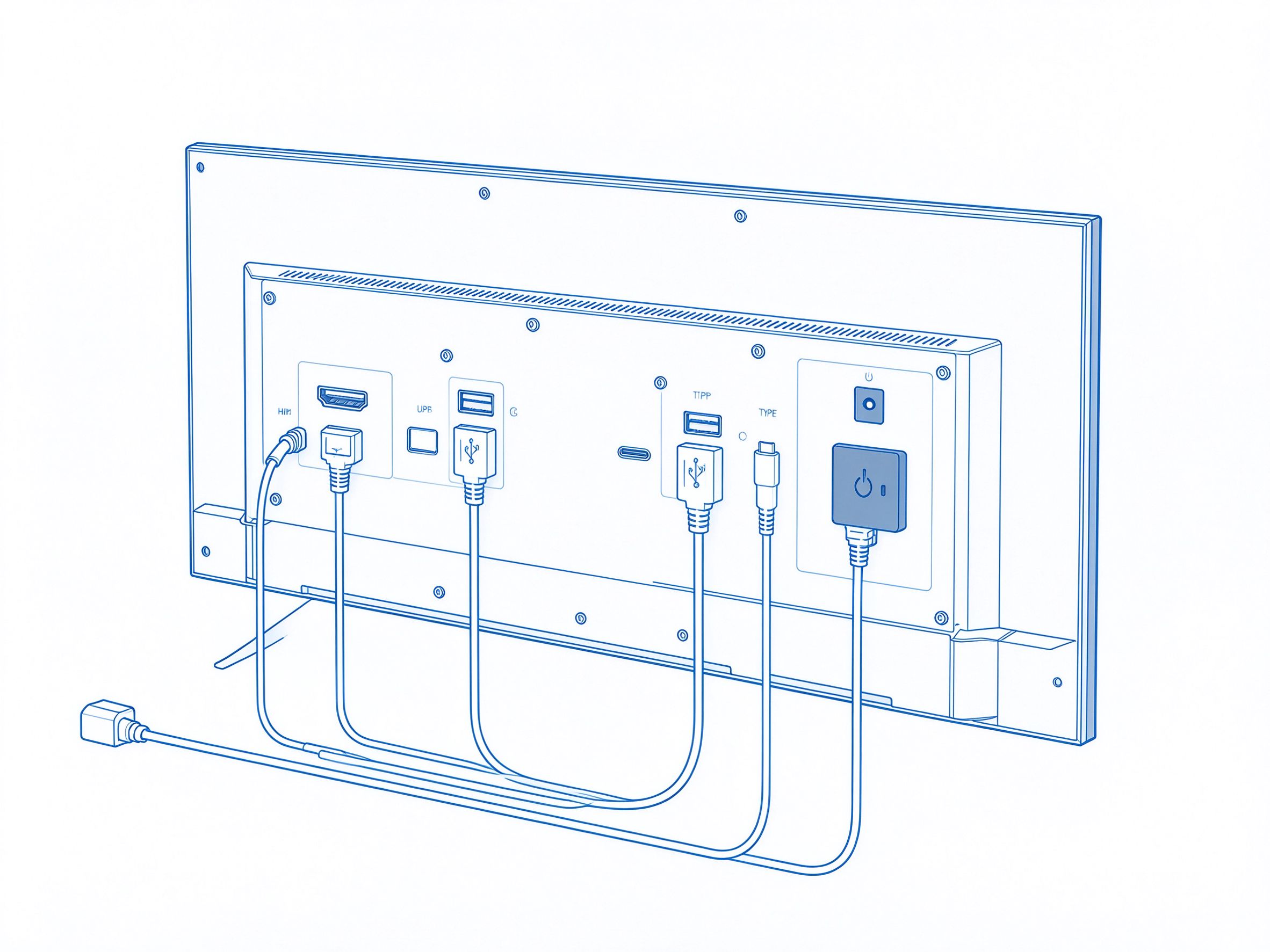
The product range covers LVDS display cables, USB signal cables, HDMI cables, power cables and touch signal cables—the complete set of conference flat panel harnesses. All products pass LVDS signal tests, USB 3.0 signal tests and plug-life tests, and complete per-piece continuity and withstand-voltage checks.
At incoming and in-process stages, FFC flat cables and coaxial wires are checked against specifications, length and appearance before storage, and terminal status is sampled after crimping; assembly stations use positioning jigs to fix branch routing, reducing human deviation. At outgoing inspection, every harness first completes a continuity test to confirm circuit continuity and correct wire sequence, then assembly quality is sampled against drawings; test records are archived by batch, ensuring that when a problem occurs it can be traced along the batch to specific production records.
Project Results
The products have been in batch delivery for 3 years, with annual supply exceeding 500,000 sets, and incoming acceptance rate and on-time delivery rate remain stable. The thin design helped the customer's conference flat panels reduce weight by about 15%. Customer satisfaction is 100%, and we have become the customer's exclusive harness supplier.
Customer feedback: the harness products are reasonably designed and stable in quality, with good consistency even after mass production, helping us solve the tight internal space problem; the cooperation has been very pleasant.
FAQ
Q: Why do conference flat panel harnesses need a thin design?
A: Under the machine slimness trend, internal installation space is limited; thin harnesses reduce thickness and occupied space while lessening impact on the machine's appearance structure.
Q: Which circuits are FFC flat cables and ultra-fine coaxial cables respectively used for?
A: FFC flat cables are used in flat routing scenarios such as display signals, replacing round-wire bundles with a flat structure; ultra-fine coaxial cables are used in high-frequency signal branches to control impedance and ensure signal integrity. The specific solution is assessed per machine signal distribution and structural layout.
Q: How does harness shielding treatment suppress interference between display and touch signals?
A: Signal branches are routed in zones by circuit type and shielded; shielding layers are crimped and connected per drawing specifications, and signal tests before shipment verify the interference suppression effect.
Q: How is signal performance consistency guaranteed in high-volume delivery?
A: Wire sequence, routing and length are fixed per drawings, key parameters are controlled, and every harness completes signal and continuity tests before shipment; test records are archived by batch for traceability.
Q: What is the sampling and cooperation process for commercial display harness projects?
A: The engineering team reviews structural and process feasibility based on drawings or samples and replies with a proposal and sampling plan; the specific lead time is confirmed with the customer's engineering team.
Contact Us
For inquiries about conference flat panel harnesses, thin integrated harnesses or other commercial display device harness solutions, please share your drawings or samples, and our engineering team will reply with a proposal and sampling plan after evaluation. Company address: 7th Floor, Unit 2, Building E1-1, Qunyi Intelligent Manufacturing Industrial Park, No. 3 Xingyuan South Road, Start-up Area, China-Korea (Huizhou) Industrial Park, Zhongkai High-tech Zone, Huizhou; email sz136138@szfandouai.cn, phone 18929363263.