
Conference Flat Panel Harness Project for a Commercial Display Manufacturer
Project Background
In recent years, smart conference flat panels have spread rapidly in office, education and collaboration scenarios, evolving from a single display terminal into a collaboration device integrating high-definition display, multi-touch and audio-video conferencing. To meet Integrated and wall-mounted conference room needs, the machine body is getting slimmer, and internal space left for harnesses is constantly squeezed by the display, motherboard and speakers; the harness must carry both power distribution and multiple high-speed signal transmissions, so design difficulty rises markedly.
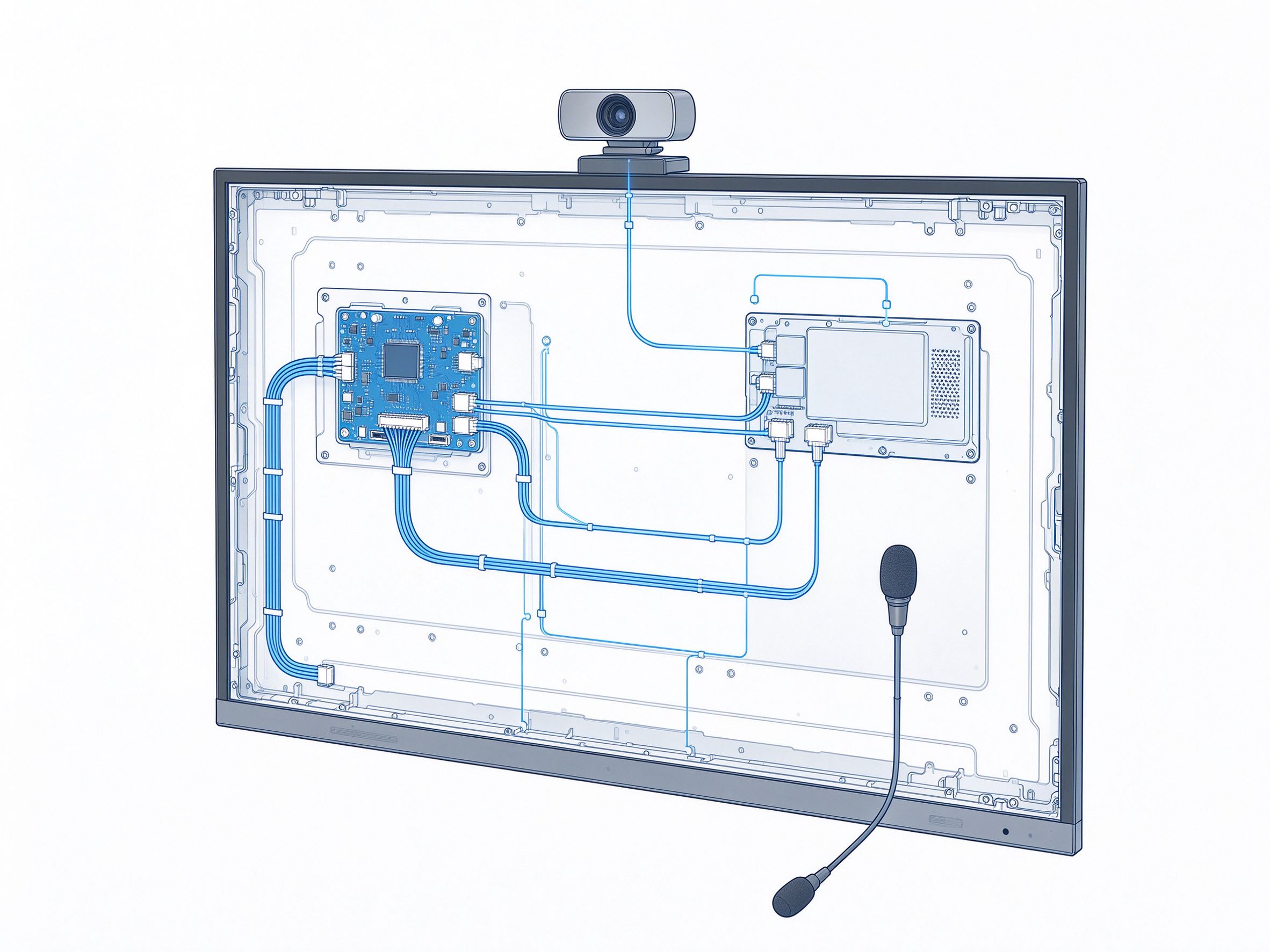
The conference flat panel shell keeps getting thinner, and the screen-to-body ratio keeps rising, leaving very limited net internal space: motherboard, power board, speakers, camera module and touch driver board each occupy their area, and the harness can only run along the shell edges and structural gaps. This requires harness design to proceed synchronously with machine structural development, aligning exit openings, branch points and fixation methods at the drawing stage to avoid later rework.
The customer of this project is a well-known domestic commercial display company whose conference flat panels integrate high-definition display, multi-touch and audio-video conferencing, with very compact internal structure. The customer needed a supplier able to support the whole journey from harness design and development to batch delivery, completing internal wiring without affecting the machine's slim appearance.
Customer Requirements
The customer required supply harnesses to be thin and highly integrated, reliably transmitting high-definition display signals, USB data, power and touch signals within limited space, without occupying volume in a way that affects the machine's slim appearance design.
Meanwhile, high-definition display and touch functions demand very high signal quality, so the customer required harnesses to stay consistent in mass production, with no mutual interference among signal branches, and the machine insertion step as simple as possible, to reduce line assembly workload.
Solution and Design/Process Highlights
Targeting the thin design requirement of conference flat panels, we developed a thin harness solution: display signal branches use FFC flat cables, replacing traditional round-wire bundles with a flat structure and greatly reducing harness thickness; high-frequency signal branches use ultra-fine coaxial cables, controlling characteristic impedance to ensure signal integrity. Meanwhile, multiple conductors are integrated into branches along the machine routing, effectively reducing the connector count and lowering the machine's assembly workload; signal branches add shielding treatment to suppress mutual interference between display and touch signals.
In branch bundling, the engineering team integrates display, touch and power circuits into neat branches along the machine routing, constraining routing with fixed clips and tape so that the harness fits the shell layout; connector selection balances insertion feel and locking reliability, making insertion on the machine line easy. At the sample stage, we cooperated with the customer on machine trial assembly, confirming spatial coordination among harness, screen, motherboard and touch module before freezing the drawings.
At the process level, harness cutting, crimping and assembly are executed per work instructions: terminal crimping parameters are confirmed at first article and then included in in-process patrol inspection; branches and sleeving are positioned per drawings; automatic continuity testing is performed on every harness before shipment, ensuring correct wire sequence and reliable connection.
Product Range and Test Validation
The product range covers LVDS display cables, USB signal cables, HDMI cables, power cables and touch signal cables—the complete set of conference flat panel harnesses. All products pass LVDS signal tests, USB 3.0 signal tests and plug-life tests before shipment, and complete per-piece continuity and withstand-voltage checks.
The plug-life test validates contact reliability of connectors under repeated insertion in the machine; signal tests check display and touch circuit signal quality in the finished unit, ensuring functions work after the harness connects to the screen and main control board. In quality process, the harness follows whole-process control of incoming inspection, in-process check and outgoing inspection: wires and connectors first undergo incoming inspection, crimping and assembly are sampled by patrol frequency, and finished products are per-piece continuity tested and checked for wire sequence, routing and labeling; test records are archived by terminal lot and serial number, supporting two-way traceability and the customer's incoming sampling and machine validation.
Project Results
The products have been in batch delivery for 3 years with stable quality, and annual supply exceeds 500,000 sets. The thin design helped the customer's conference flat panels reduce weight by about 15%, and internal wiring space improved markedly. Customer satisfaction is 100%, and we have become the customer's exclusive harness supplier.
Customer feedback: the harness products are well designed, neatly routed and reliable, helping us solve the tight internal space problem; the cooperation has been very pleasant.
FAQ
Q: Why do conference flat panel harnesses need a thin design?
A: The machine pursues a slim appearance, leaving very limited internal space; thin harnesses reduce thickness occupation while reliably transmitting display, touch, power and other signals, so that the harness does not affect the machine's appearance and assembly.
Q: Where are FFC flat cables and ultra-fine coaxial cables respectively used?
A: Display signal branches use FFC flat cables whose flat structure fits edge routing; high-frequency signal branches use ultra-fine coaxial cables that ensure signal integrity by controlling characteristic impedance, with materials selected by signal type.
Q: How is mutual interference between display and touch signals avoided?
A: Signal branches add shielding treatment, shielding grounding and continuity are executed per drawings, and signal tests before shipment verify that display and touch circuits do not interfere with each other.
Q: How is harness consistency guaranteed in large-volume delivery?
A: Wire sequence, routing and branch positions are fixed per drawings, first article inspection is combined with in-process patrol inspection, every batch is compared with the confirmed sample, and batch traceability records are retained.
Q: How is a new project arranged from discussion to sampling?
A: After the customer provides the machine structure or harness drawings, the engineering team evaluates the solution and process route, and samples and validation nodes advance per the project plan and customer confirmation.
Contact Us
For inquiries about conference flat panel thin harnesses, internal harnesses for commercial display devices or other customized harness solutions, please share your drawings or machine structure information, and our engineering team will reply with a proposal and sampling plan after evaluation. Email sz136138@szfandouai.cn, phone 18929363263 (WhatsApp +86 18929363263). We are located at 7th Floor, Unit 2, Building E1-1, Qunyi Intelligent Manufacturing Industrial Park, No. 3 Xingyuan South Road, Start-up Area, China-Korea (Huizhou) Industrial Park, Zhongkai High-tech Zone, Huizhou.