
Rapid Development of the Commercial Display Industry Drives Growth in Wiring Harness Demand
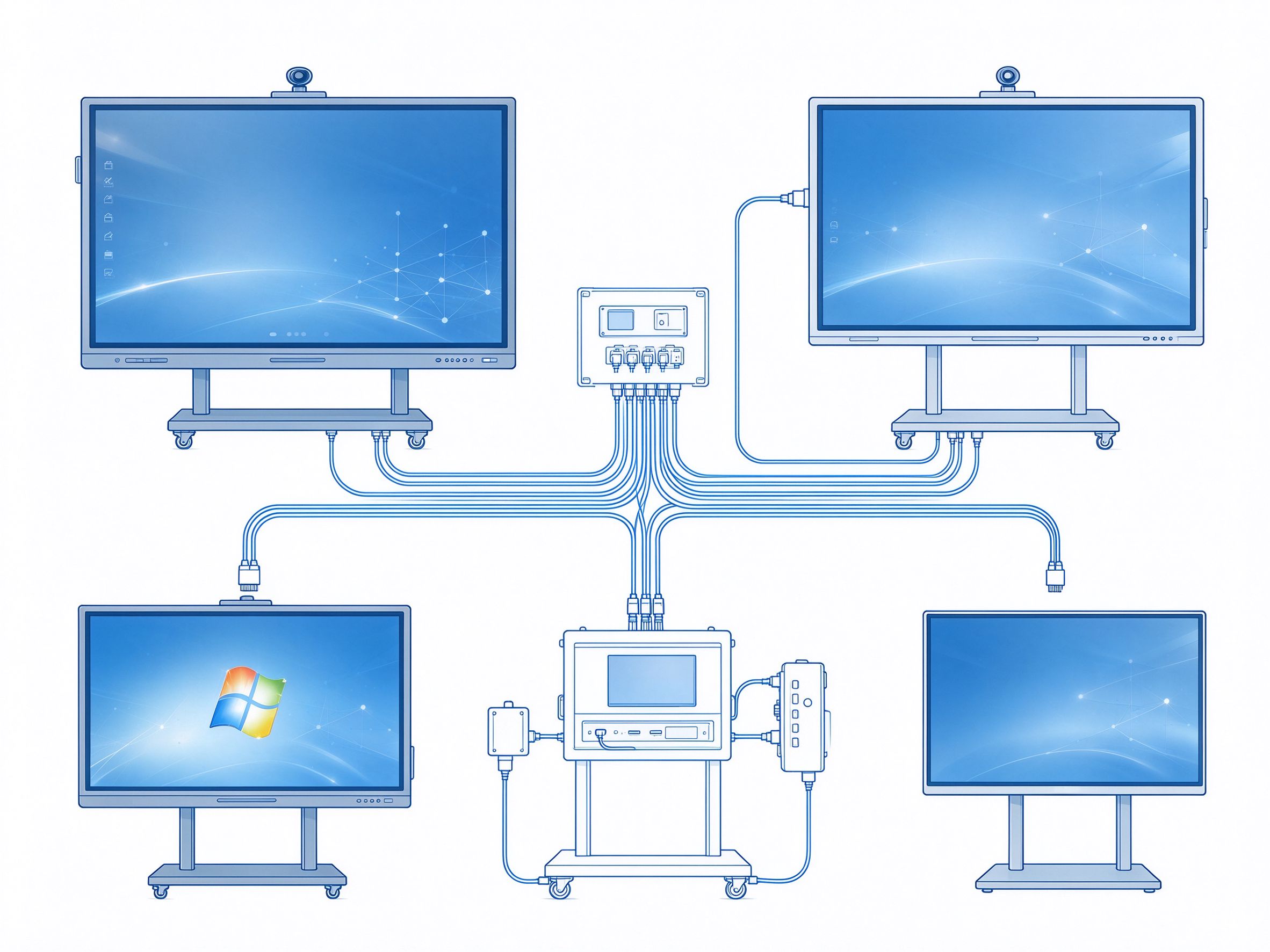
Market Review: Commercial Display Volume Drives Harness Demand Growth
In recent years, the commercial display industry has developed rapidly, and shipments of conference flat panels, advertising players, digital signage and smart screens have kept growing. These products all require a large number of internal harness connections, including LVDS display cables, USB signal cables and power cables, so demand for commercial display harnesses is growing rapidly.
Commercial display products are widely deployed in conference rooms, retail stores, buildings and public spaces; the machine's long-term continuous operation places high requirements on internal connection stability. The integration of display, touch, audio and video functions means a single machine simultaneously carries high-speed display signals, data signals and power circuits, so harness types and branch counts increase accordingly.
A common feature of commercial display products is high functional integration, large display area and open operating environment; the machine internally arranges power board, main control board, display module and touch unit together, and the harness carries connection and signal transmission tasks among these units.
Industry Background: Thinner and Higher-Definition Designs Raise Harness Requirements
As commercial display products move toward being thinner, higher-definition and more intelligent, harness requirements keep rising: LVDS cables need higher transmission rates to support high-definition display; USB cables must support USB 3.0/3.1 high-speed transmission; power cables need greater current-carrying capacity. Meanwhile, the compact internal space imposes higher requirements on harness integration and miniaturization, so thin solutions such as FFC flat cables and ultra-fine coaxial cables are used increasingly.
Thinner means the routing space left for harnesses inside the machine is greatly compressed, and traditional round-wire bundled solutions can hardly meet design requirements in thickness and volume; high-definition and high-speed interfaces require the harness to control loss and interference during transmission, and once display signals develop quality defects at the harness stage, they appear directly as screen artifacts, flickering or touch failure. Therefore, thin structure and signal integrity have become the two cores of commercial display harness solutions.
Take a conference flat panel as an example: high-definition display signals, touch signals, USB data and power circuits run in parallel within a narrow space; once crosstalk among them exceeds the design margin, it shows as display abnormality or touch failure, so shielding and zoned routing become the focus of solution design.
Our Commercial Display Harness Line and Custom Capability
We have developed a complete commercial display harness product line, covering conference flat panels, advertising players, digital signage, smart screens and LED displays, providing multiple harness types such as display, signal and power, and customizing length, wire sequence and branch structure according to machine drawings.
Aiming at the thin-design need, we can offer thin solutions such as FFC flat cables and ultra-fine coaxial cables, with display branches and data branches shielded as required; multiple circuits are integrated into branches along the machine routing, effectively reducing the connector count and lowering the machine's assembly workload. In production, wire sequence, routing and length are fixed on jigs, branches are gathered with tape or sleeving, and the harness is neatly coiled per drawings before packaging and shipment.
In structural handling, multiple circuits are integrated into neat branches along the machine routing, and branches are gathered with tape or sleeving; both ends of the harness carry clear wire numbers or labels, making it easy to identify circuits quickly during final assembly and to locate them by label during later maintenance.
Quality and Inspection Assurance
Although commercial display harnesses do not involve high-power scenarios, the machine's long-term continuous operation places very high requirements on consistency. We run a complete quality-control process: incoming material inspection, in-process inspection of crimping and assembly, and outgoing final inspection; continuity testing is a mandatory pre-delivery item, and each harness is checked against the drawings for wire sequence, routing and labeling before shipment.
High-speed signal branches complete corresponding signal tests per drawings and technical agreements, and inspection records are archived by batch; from small-batch sampling to mass production, the same process and inspection specifications are used, and tooling, jigs and work documents are separately archived, ensuring repeat-order batches match the first order.
The sampling stage supports development from drawings or samples; after sample delivery, interfaces are checked item by item with the customer; tooling, jigs and inspection specifications are fixed synchronously during sampling, ensuring samples and mass-production products match in quality.
FAQ
Q: Internal space in conference flat panels is tight—how is the harness made thin?
A: Display branches can use FFC flat cables to replace round-wire bundles with a flat structure, high-frequency branches use ultra-fine coaxial cables, and integrated branches reduce connectors and insertion points, compressing the harness's overall thickness and volume.
Q: High-definition display shows screen artifacts or flickering—is it related to the harness?
A: It may be. Display signals are sensitive to transmission loss and interference; abnormal shielding structure or wire sequence can cause display abnormalities, and the problematic circuit can be located through continuity and signal tests.
Q: Can commercial display harnesses be customized according to machine drawings?
A: Yes. Length, wire sequence, branch structure and exit direction are all customized to machine drawings, and tooling and inspection specifications are fixed during sampling.
Q: How are the order quantity and lead time for a new project determined?
A: Assessed per project. After drawings or samples are provided, the engineering team replies with sampling and batch arrangements based on product structure and validation pace, and details can be confirmed during review.
Contact Us
In the future, as the commercial display market keeps expanding and display technology upgrades, commercial display harnesses will move toward being thinner, faster and more integrated. We will keep optimizing product solutions and provide commercial display customers with connection solutions that better fit machine design.
For commercial display harness supply support, please share your drawings or samples, and our engineering team will reply with a proposal and sampling plan after evaluation. We are located at 7th Floor, Unit 2, Building E1-1, Qunyi Intelligent Manufacturing Industrial Park, No. 3 Xingyuan South Road, Start-up Area, China-Korea (Huizhou) Industrial Park, Zhongkai High-tech Zone, Huizhou; email sz136138@szfandouai.cn, phone 18929363263 (WhatsApp +86 18929363263).