
5G Base Station Communication Harness Project
Project Background
5G base stations carry high-bandwidth, low-latency communication services, and equipment is distributed in equipment rooms and tower tops; it must meet the electrical performance requirements of high-speed signal transmission while adapting to outdoor environments such as sun, rain and temperature swings. Base-station internal connecting cables and antenna feeders are exposed or run in sealed cabinets long term, so harness shielding design and weatherability directly affect communication quality and network reliability.
Communication network construction keeps advancing toward wide coverage and large capacity, with base-station sites ranging from macro sites to indoor distribution scenarios, and centralized equipment-room deployment coexisting with remote tower installation. For harness suppliers, high-frequency electrical performance design and outdoor environmental adaptability must be provided simultaneously; signal degradation in any branch can turn into network-indicator fluctuation, so test validation and batch consistency management are especially critical in communication harness projects. By site type, equipment rooms mainly carry high-speed connections among devices, while tower tops and antenna side endure climate long term, so harness design must distinguish selection and protection requirements by installation position.
The customer of this project is a communication equipment enterprise whose 5G base-station equipment is already used in multiple domestic base-station projects, needing the complete set of harness supply adapted to both high-speed signals and outdoor environments. Early in the project, we held solution review targeting high-frequency signals and outdoor conditions.
Customer Requirements
The customer is a communication equipment enterprise whose 5G base-station equipment requires supply harnesses with high-speed signal transmission capability, meeting 5G communication's high-bandwidth and low-latency technical requirements; meanwhile, base-station equipment is distributed outdoors in equipment rooms and tower tops, so harnesses must also adapt to complex environments such as sun, rain and temperature swings.
Solution and Design/Process Highlights
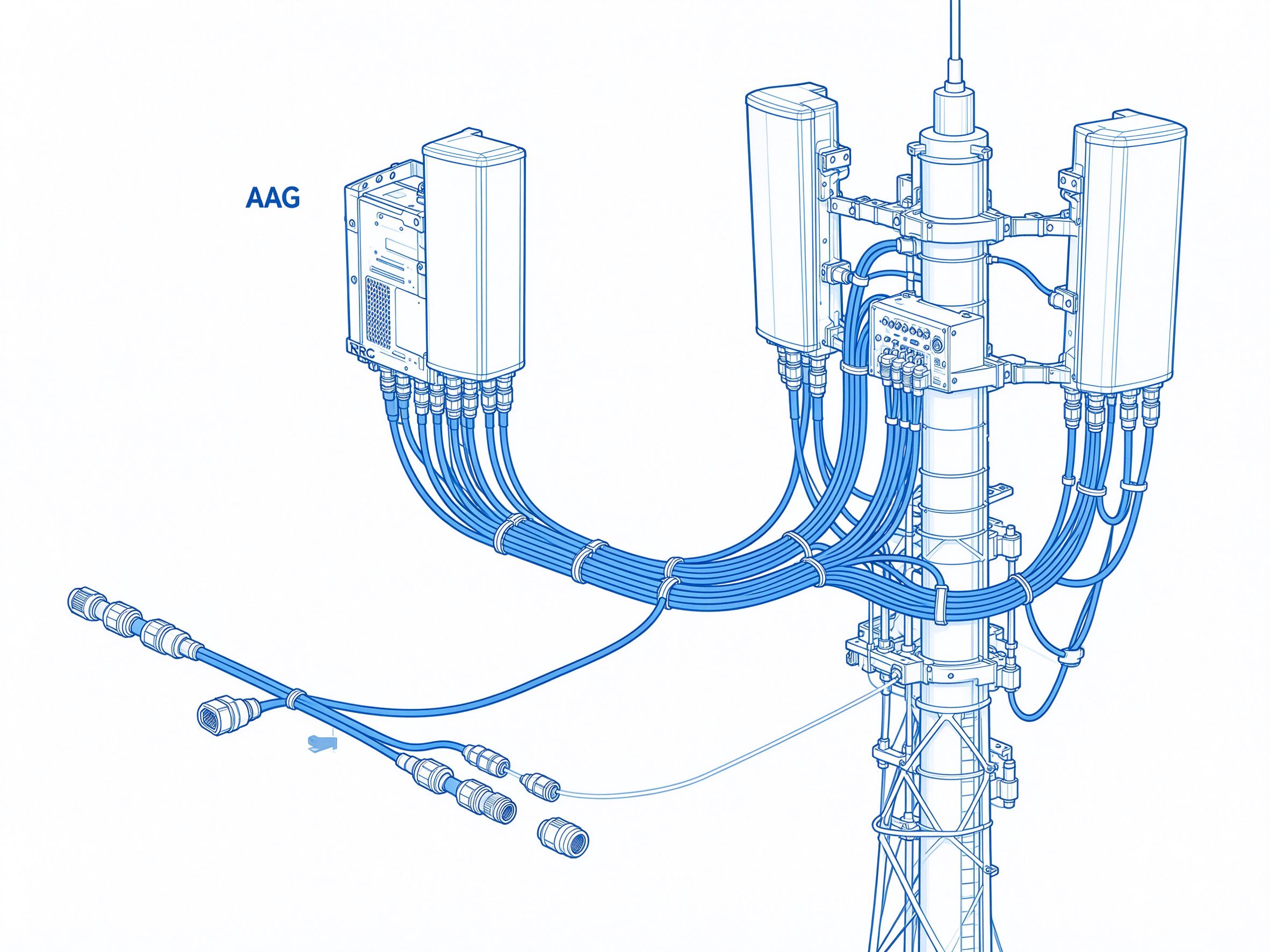
Targeting high-speed signal transmission, we selected a combination of CAT6A network cables, coaxial cables and optical fibers: CAT6A network cables use a twisted-pair structure to reduce inter-wire crosstalk; high-frequency branches use coaxial cables with dual shielding of aluminum foil plus braiding to suppress external electromagnetic interference and guarantee eye opening and insertion-loss indicators. For outdoor scenarios, we selected weather-resistant jacket wires and waterproof connectors, improving adaptability to temperature swings and humidity.
In branch handling, twisted-pair network cables keep consistent pitch and lay length to maintain crosstalk indicators, and coaxial-branch shielding layers are treated at crimp ends per process requirements to ensure shielding continuity; outdoor connector sealing and waterproof structures are fixed per assembly process, and confirmed by continuity and appearance checks after assembly. The whole bundle is tied and fixed along cabinet routing, avoiding mutual rubbing that damages jackets.
In process control, high-frequency harness crimping and assembly follow controlled processes: incoming inspection checks wire and connector specs, crimp parameters and coaxial-end treatment are confirmed one by one per work instructions, and after assembly wire sequence and shielding treatment are rechecked against drawings. Before shipment, every harness completes high-frequency tests and continuity and withstand-voltage checks, and batch and terminal-lot records are archived with the product for traceability.
The project advances through the APQP process: the high-frequency solution is frozen only after passing the customer's communication performance test at the sample stage; design changes go through review and customer confirmation, ensuring batch delivery matches the validated sample.
Product Range and Test Validation
The product range covers base-station internal connecting cables, antenna feeders, power harnesses, control signal harnesses and the complete set of 5G base-station harnesses. All products pass high-frequency signal tests, eye diagram tests, insertion loss tests as well as continuity and withstand-voltage checks.
At incoming, CAT6A network cables, coaxial cables and waterproof connectors are checked for spec and appearance, and crimping and shielding treatment are confirmed station by station; high-frequency tests are run in a controlled environment, and test data are saved by batch for reference. High-frequency tests cover key indicators such as signal quality and transmission loss, and test samples and batch products follow the same process and inspection standards; when the customer's communication performance test needs traceability, corresponding test records can be pulled by batch number.
Project Results
The products passed the customer's strict communication performance tests, with stable batch delivery quality and annual supply exceeding 1 million sets; they are applied in multiple domestic 5G base-station projects and run stably and reliably.
Customer feedback: the harness products perform stably with good signal quality, meeting the high standards of 5G base stations; you are a professional and reliable communication harness supplier.
FAQ
Q: Why do 5G base-station harnesses use a combination of CAT6A network cables, coaxial cables and optical fibers?
A: Different circuits differ in transmission bandwidth and anti-interference requirements; the combined solution selects by signal type: twisted-pair reduces inter-wire crosstalk, and coaxial with dual shielding suppresses external electromagnetic interference. The specific configuration is assessed per base-station equipment architecture.
Q: How do outdoor base-station harnesses adapt to complex environments?
A: Outdoor parts use weather-resistant jacket wires and waterproof connectors, improving adaptability to sun, rain, temperature swings and humidity.
Q: Which tests do high-frequency harnesses undergo before shipment?
A: High-frequency signal tests, eye diagram tests, insertion loss tests as well as continuity and withstand-voltage checks are executed batch by batch per inspection specification, and test records are archived by batch.
Q: How is high-frequency performance kept consistent in base-station batch production?
A: Cable selection, twist pitch, coaxial crimping and shielding treatment are all executed per fixed processes, and every batch completes high-frequency signal, eye diagram and insertion loss tests before shipment, with records traced by batch.
Q: What is the sampling process for communication harness projects?
A: The engineering team evaluates high-frequency performance and process feasibility based on drawings or samples and replies with a proposal and sampling plan; the specific schedule is confirmed with the customer's engineering team.
Contact Us
For inquiries about 5G base-station harnesses, high-frequency communication harnesses or other communication device harness solutions, please share your drawings or samples, and our engineering team will reply with a proposal and sampling plan after evaluation. Company address: 7th Floor, Unit 2, Building E1-1, Qunyi Intelligent Manufacturing Industrial Park, No. 3 Xingyuan South Road, Start-up Area, China-Korea (Huizhou) Industrial Park, Zhongkai High-tech Zone, Huizhou; email sz136138@szfandouai.cn, phone 18929363263.