
Pre-release appearance and label check, packaging protection, and warehouse handover
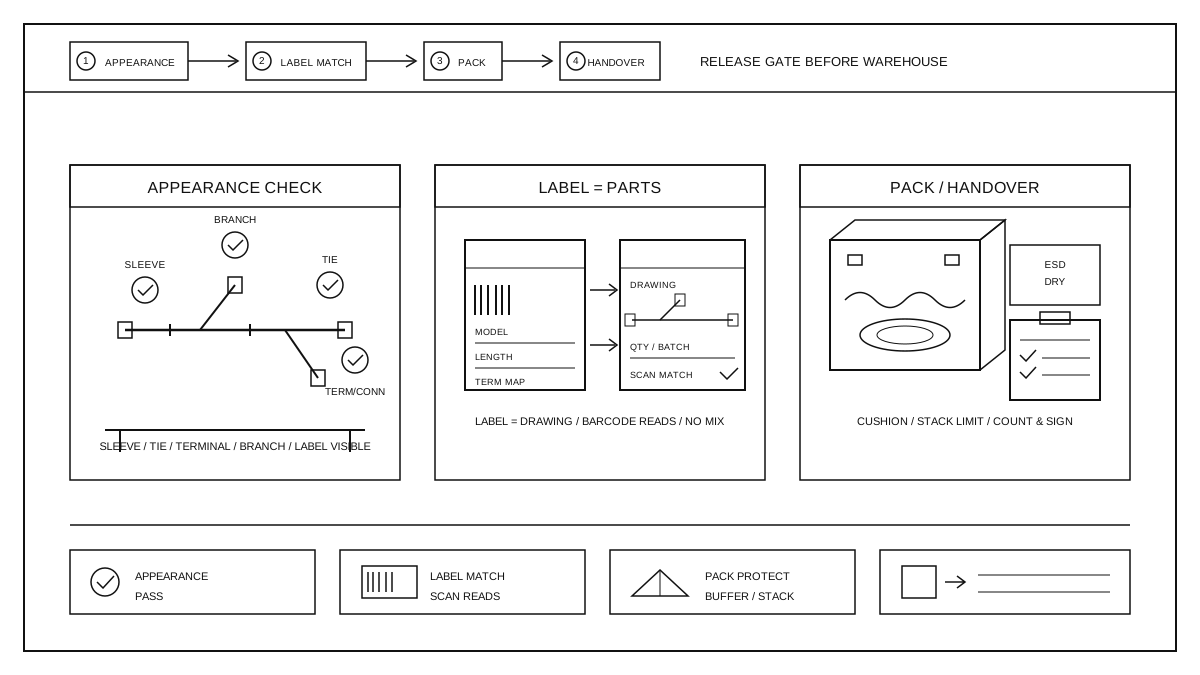
Inspection items and judgments for appearance review before going offline
After the entire harness is fully assembled and passes the previous inspection, an appearance review is conducted before it goes off the production line; this is the final manual visual inspection before release to storage. The inspection items are checked one by one according to the work instructions: whether the sheath and corrugated tubes are damaged, cracked, or misaligned; whether the cable ties are cut flush and if there is any leftover edge lifting; whether the terminals and connector housings are deformed, scorched, or have bent pins; whether the branch routing matches the drawings and if there is any crossing or twisting; whether the labels on the harness are attached correctly and if the markings are clear and legible. Judgments are divided into three categories: qualified for release, defective for rework and reinspection, or abnormal for quarantine review. The appearance review does not replace electrical inspection; it only confirms that the entire harness has no visible mechanical damage or misalignment after assembly and handling. If there is any uncertainty in any item, judgment should be made according to the drawings and work instructions; release should not be based on experience.
Label and physical item consistency review
After the appearance passes inspection, check each item on the label against the actual product to prevent mixing materials or incorrect labeling. The items to verify include: whether the specifications and model on the label match the actual product, whether the total harness length and branch lengths match the drawings, whether the connectors at both ends and terminal positions correspond to the label terminal diagram, and whether the label barcode can be read normally by a barcode scanner. Compare the scanning result with the work order system; release only if they match. If the barcode is blurry, detached, or cannot be scanned, reapply the label and rescan; do not manually rewrite the code. Harnesses from different batches or different models should be physically separated in the verification area, and the circulation card should accompany the harness to avoid mixing adjacent batches. Consistency verification only confirms the correspondence between the label and the product; it does not redesign the label system. The label coding rules and printing specifications should follow existing documents.
Packaging Protection Methods and Selection Logic
The bundles that have passed inspection should be packaged according to the packaging operation instructions and protective methods should be selected. For cushioning, protective sleeves or layers should be added to fragile parts such as connectors and terminals to prevent bumps during transportation; for compression protection, bundles should be coiled according to their natural shape without forcing sharp bends, cushioning materials should be filled inside the box, and stacking height should be controlled according to the packaging documents. For moisture protection, moisture-proof measures should be implemented according to customer requirements, and exposed terminals should be protected against dust. For static electricity and cleanliness, bundles with electrostatic sensitive components should use anti-static packaging as required, and surfaces with cleanliness requirements should be dusted before packing. The packaging method should be chosen based on three factors: harness shape, transport distance, and customer requirements: use turnover boxes for short-distance transport, cardboard boxes with cushioning for long-distance shipping, and special requirements should follow customer packaging specifications. The packaging method should be clearly documented in the operation instructions and should not be altered on-site.
Warehouse Handover and Exception Rollback
After packaging is completed, proceed with the warehouse handover. During the handover, first verify the quantity, and check bundle by bundle according to the work order; no order is issued if the quantity does not match. Each batch should be marked with batch number and status: qualified pending inspection, qualified for storage, and abnormal isolation, all separated into three areas, with status recorded on the circulation card. The handover documents should accompany the goods, with signatures from both parties confirming, clearly recording batch, quantity, status, and handover time. If a shortage, appearance anomaly, or label mismatch is found during the handover, the entire batch is temporarily withheld and not stored; it is returned to the verification area for processing according to the abnormality procedure, and after processing, the handover is repeated. After storage, batches are shelved according to batch number, following the first-in, first-out principle, with status markings maintained until outbound. Handover and verification records are archived together and can be traced to specific batches and operators.
Interface with upstream and downstream processes
Final check before offline, connecting upstream and downstream: Upstream is responsible for assembly execution and error-proofing at the final assembly workstation. Only harnesses that have completed final assembly and passed first-piece inspection can enter this line; this line does not repeat assembly actions or redo electrical inspections, only confirming release for appearance, labels, and packaging. Downstream for warehousing and shipping: Verified, packaged, and handed-over harnesses enter the warehouse awaiting dispatch, with FIFO (first in, first out) applied at outbound. Any appearance or label issues found on this line must be reported back to the assembly workstation, distinguishing whether they were caused by assembly or transit damage, and addressed in the pre-shift meeting. Custom harness drawings, samples, and special packaging requirements are executed according to customer-approved process documents. Details of custom harness capabilities can be found at custom harness capability.