
Harness turnover and protection before final assembly: tool selection, support points, anti-crush protection and handover inspection
Process Boundaries: What Turnover Protection Needs to Solve
When a harness is taken offline as a whole, its shape is correct, but after handling, stacking, temporary storage, and handover, it may be bent, branches may be folded back, or the sheath may be pushed out. The task of turnover protection is to maintain the harness's routing, branch angles, and sheath positions unchanged during this period that does not add assembly value. Turnover tools do not bear electrical performance and cannot replace final inspection; they only address shape maintenance and placement order. Drawings or work instructions should indicate the harness's overall profile, allowed support positions, areas prohibited from being pressured, and placement directions, and the site should check against the drawings.
Turnover Tools and Support Point Layout
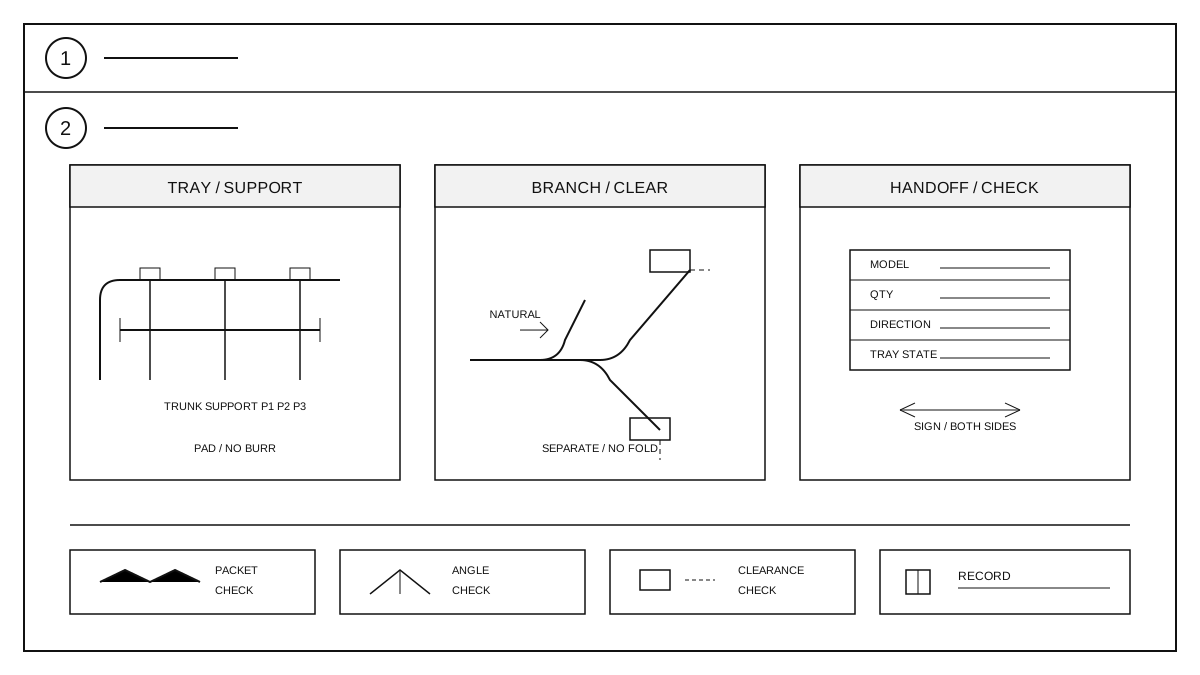
Turnover tools are selected according to the harness's overall shape, weight, number of branches, and production rhythm. Pallets, divider racks, and hanging devices should allow the harness to be placed in the assembly posture, with continuous support for the main trunk and independent clearance for branches. Support points are placed on straight sections of the main trunk and near the base of branches, avoiding connectors, sheath ends, weld points, and vulnerable branches. Support surfaces should be flat, burr-free, and soft pads should be added at harness contact points. The tools should be labeled with the harness model, placement direction, and maximum stacking layers, and different models should not be mixed.
Harness Shape and Branch Protection
Within the tools, the harness should maintain its natural routing; the main trunk should not be forcibly bent, and branches should not be folded back or pressed against the main trunk. Long branches should have their own clearance or be separated by soft strips to prevent mutual pressure. Sheath ends must not press against the tool's side walls, and connectors must not bear the harness's weight. If stacking is required, follow the layer count and isolation method specified in the process documents, with heavier items at the bottom and lighter items on top. During turnover, tools, parts, or bins must not be placed on the harness, nor should the harness be temporarily tied to the tool with cable ties.
Handling, Temporary Storage, and Handover
Handle according to the force points designed on the equipment, do not grasp branches, do not lift connectors, and do not drag the sheath. When the turnover cart passes through thresholds, ramps, and turns, slow down to prevent the entire bundle from shifting inside the equipment. Keep the temporary storage area dry, ventilated, and free from direct heat sources; the entire bundle should not touch the walls, be placed on the ground, or come into contact with oil or cutting fluid. During handover, both parties verify the bundle model, quantity, branch direction, and equipment condition according to the same turnover card. Any shifting, bending, or sheath displacement should be recorded on the spot and not carried into the next process.
Inspection, Rework, and Record Keeping
Inspect the overall shape of the bundle, the main trunk routing, branch angles, sheath position, connector orientation, and equipment support status. For the first piece, confirm placement direction and support points; during inspections, randomly check the base of branches and equipment padding; before handover, recheck the bundle for indentations or deformation. During rework, first remove the bundle from the equipment, inspect the shape in its free state, and then restore it according to the drawing; branches must not be forcibly bent back inside the equipment. After replacing equipment or changing stacking methods, reconfirm the support points. For downstream custom interfaces, see custom harness capability.