
Nonconformance isolation, rework and reverification after offline
Determination and Identification of Abnormal Products
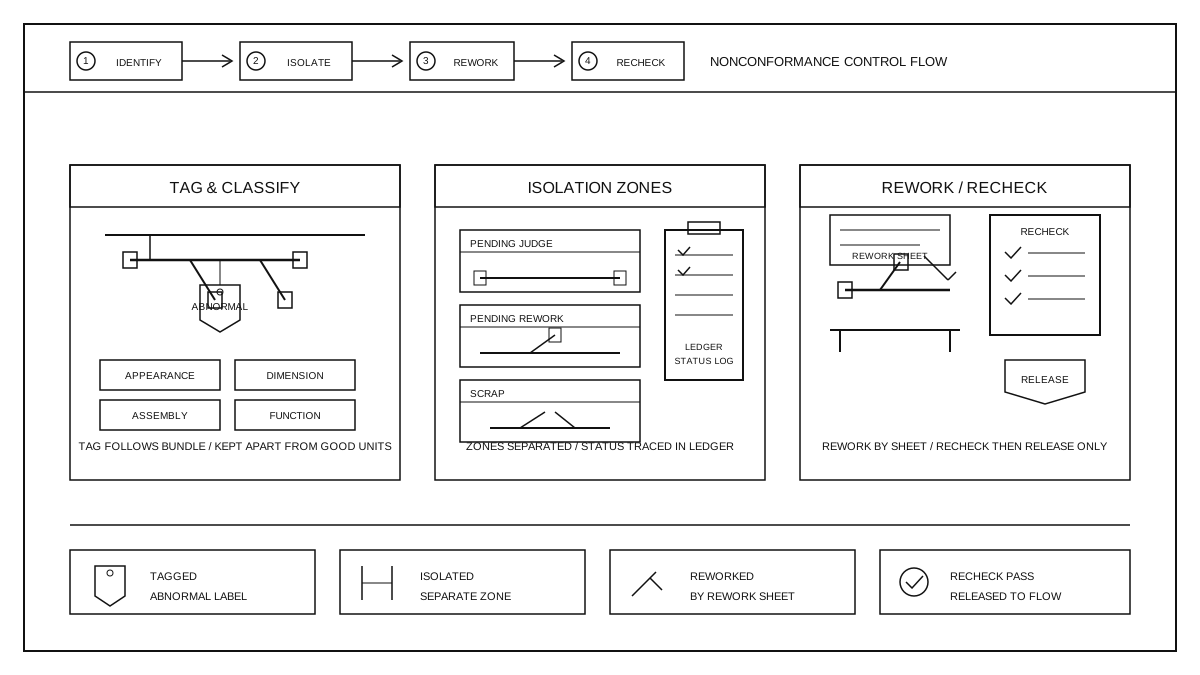
For harnesses judged as rejected during offline review or inspection, first classify them according to the type of defect, then attach an abnormal label, clearly distinguishing them from qualified products both visually and in handling. Defects are usually categorized as appearance, dimension, assembly, and functional: appearance defects refer to visible damage or misalignment on the sheath, corrugated tube, cable tie, or surface parts; dimension defects refer to total length, branch routing, or assembly position inconsistent with the drawing; assembly defects refer to terminals, connectors, or branch structures inconsistent with the drawing; functional defects refer to issues exposed during previous electrical or continuity tests. This step only records the defect type and status label, without performing further testing. The label travels with the harness: abnormal products are tagged with a conspicuous abnormal label indicating batch, workstation, judgment type, and discovery stage; the label's color and shape differ from qualified product labels to prevent misuse at adjacent workstations. Label information is recorded in the transfer card and abnormal ledger and must not be removed before the judgment is finalized; if a batch contains both qualified and abnormal products, physically separate them first and then label separately. This process only handles post-judgment labeling and differentiation and does not alter the inspection conclusion; whether a product is qualified is determined by the corresponding inspection record.
Isolation Area and Isolation Management
Harnesses judged as defective are placed in a dedicated isolation area and are not stored together with qualified or pending inspection harnesses. The isolation area is further divided based on status: the pending judgment area awaits further review, the pending repair area awaits repair plans and work arrangements, and the scrap area awaits disposal. Each area has clearly defined boundaries and labels on the floor or shelves, with unidirectional flow and no cross-area mixing. Isolated items are logged individually in a ledger, recording batch, model, type of defect, entry time, current status, and handler, with each ledger entry corresponding to a physical label. Status transitions are controlled: moving from pending judgment to pending repair requires a review conclusion, moving from pending repair to scrap requires a scrap decision, and moving from completed repair to re-inspection requires a repair record. Each status change is documented in both the ledger and the transfer card, and items do not proceed to the next stage without completing the process. The isolation area is regularly inventoried to ensure ledger and actual items match. Isolated items do not enter packaging or warehousing with normal batches to prevent defective items from migrating downstream. Isolation management controls only status and ledger and does not replace technical review; review conclusions are executed according to existing quality documents.
Repair Boundaries and Repair Operations
Before repair, determine whether repair is possible or not. A situation where repair is possible refers to defects that can be eliminated through clear processes such as replacement, organization, or adjustment, and the repair does not affect the harness structure or usage requirements; a situation where repair is not possible refers to damage that exceeds the manageable scope, structures that cannot be restored, or repair plans that cannot ensure consistency and reliability. Determination should be carried out according to the evaluation criteria and the work instructions, and repairs should not be decided on site. For harnesses that can be repaired, a repair plan and work instructions should be developed first: clearly specify the repair location, repair steps, materials and tools to be used, and post-repair organization requirements; repair work is to be carried out at designated workstations, and operators must follow the plan without making changes to other parts beyond the scope. The repair process should keep records: each repair location, handling method, replaced materials, operator, and completion time should be recorded on the repair form, which accompanies the harness. If new or deeper defects are found during repair, stop the repair and return the harness to the isolation area for re-evaluation, without arbitrarily expanding the repair scope; the repair boundary is determined by the plan, and any changes outside of the plan must be re-evaluated before execution.
Re-inspection and release after repair
The harnesses that have completed repair enter reinspection, with the reinspection scope separated from the normal offline review area: reinspection first verifies whether the repaired parts have been treated according to the repair plan, then checks for any new damage around the repaired parts, and finally confirms each item according to the reinspection checklist; the scope of reinspection items is carried out according to the judgment criteria and operating instructions, and the testing methodology is not elaborated here. Only after passing the reinspection can the harnesses be released: repair records must be complete, reinspection records must be complete, status labels must be changed from abnormal to qualified, and the ledger must be updated accordingly before proceeding to the normal pending flow. If reinspection fails, the harness is returned to the isolation area for reassessment according to the new abnormal category; if the same part still does not meet standards after repair, it is handled according to the non-repairable process. Compared with normal offline review, reinspection adds a step for tracing the repair: the repaired parts, repair records, and original abnormal ledger must correspond, and the reinspection conclusions along with release records are archived to trace back to the repair process and reinspection personnel. Harnesses that fail reinspection are not released and do not enter packaging or storage.
Interface with upstream and downstream processes
Abnormal isolation and rework re-verification serve as a bridge: Upstream appearance and identification checks before line-off and previous process inspections are performed; only harnesses judged as rejected enter this process. In this process, line-off rechecks are not redone, nor are packaging design or storage handover details redone, only controlled handling of abnormal items is carried out. Downstream outbound and shipment: Only harnesses that pass re-inspection and whose status is changed to qualified return to the normal circulation queue, and are handled according to existing storage and outbound procedures; records generated from isolation and rework in this process serve as a basis for quality tracing and feedback. Discovered abnormalities are fed back in reverse to the corresponding workstation according to category, distinguishing whether they are caused by assembly or circulation damage, and reported for rectification in the pre-shift meeting. Abnormal handling of customized harnesses is carried out according to customer-confirmed process documents. The capacity for customized harnesses can be found at custom harness capability.