
Twisted-pair and shielded-pair process for wire harnesses: pitch, untwisting, termination and batch inspection
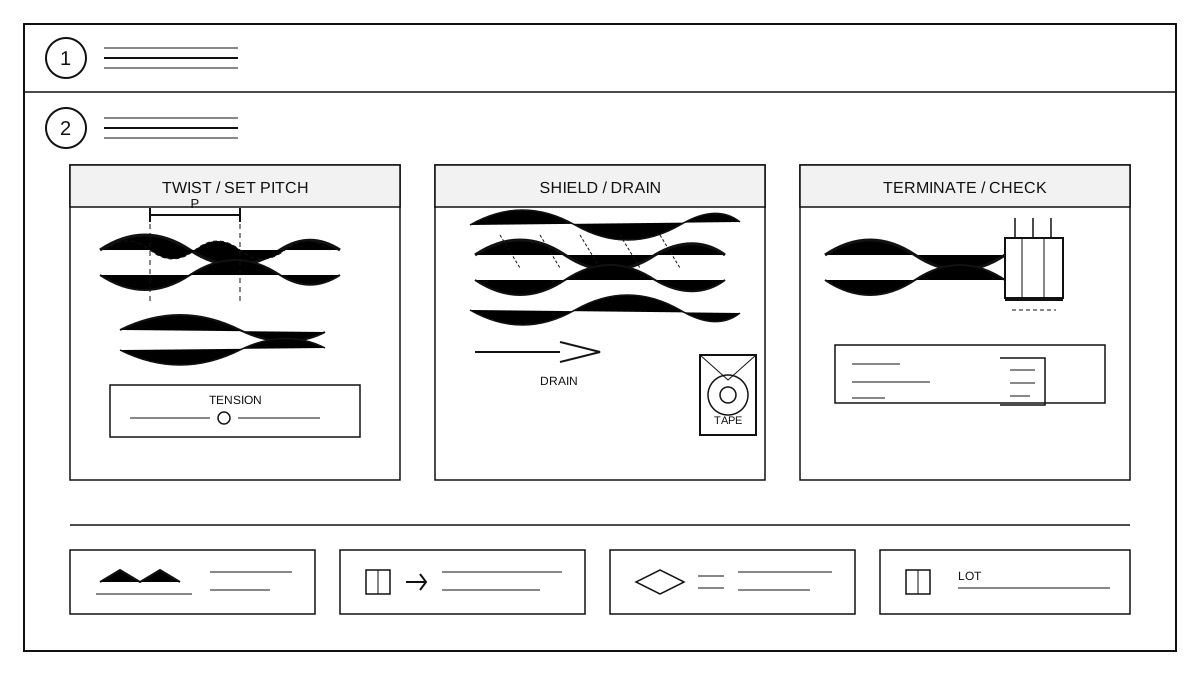
Process boundary: when to twist and when to shield
Twisted pairs suit differential signals, vehicle buses, sensors and low-speed lines that are sensitive to interference. Shielded pairs suit areas with external noise or tighter electromagnetic compatibility requirements. Select by signal rate, wire gauge, pitch, shield type, termination and bending space. Do not twist every wire: pair the signal with its return, and never twist only the signal while leaving the return loose.
Pitch and untwisting control
Set the pitch from the drawing or signal requirement. Keep both wires under equal tension while twisting; one loose wire makes the pitch drift along the run. Measure pitch at the first, middle and last article with a pitch gauge or caliper and record the result. Untwist only the length needed for crimping or soldering; never untwist the whole run. Keep the drain wire of a shielded pair according to the termination method.
Shield wrap and continuity
Wrap the shield tape in one direction with the overlap stated in the process document. Do not crush the insulation, and leave enough shield length for termination. Connect the shield to the connector shell or a dedicated terminal; do not rely on tape alone. The two wires of a shielded pair must not cross or swap at the termination.
Termination and crimping
Select the crimp tool by terminal size and match the strip length to the crimp window. After crimping, check the indentation, cross-section and pull-out result. Terminate the drain wire separately; never share a crimp barrel with a signal wire. Recheck pitch and shield continuity after termination, because handling can stretch the pair.
Inspection and batch records
Check pitch, untwisted length, shield wrap direction and overlap, crimp indentation, shield continuity, wire order and label. Record first-piece, in-process and last-piece pitch and termination results. For rework, untwist from the end again and do not stack a new crimp on the old one. For the downstream customization interface, see custom harness capability.