
New Requirements of the High-Voltage Platform for Wiring Harness Technology
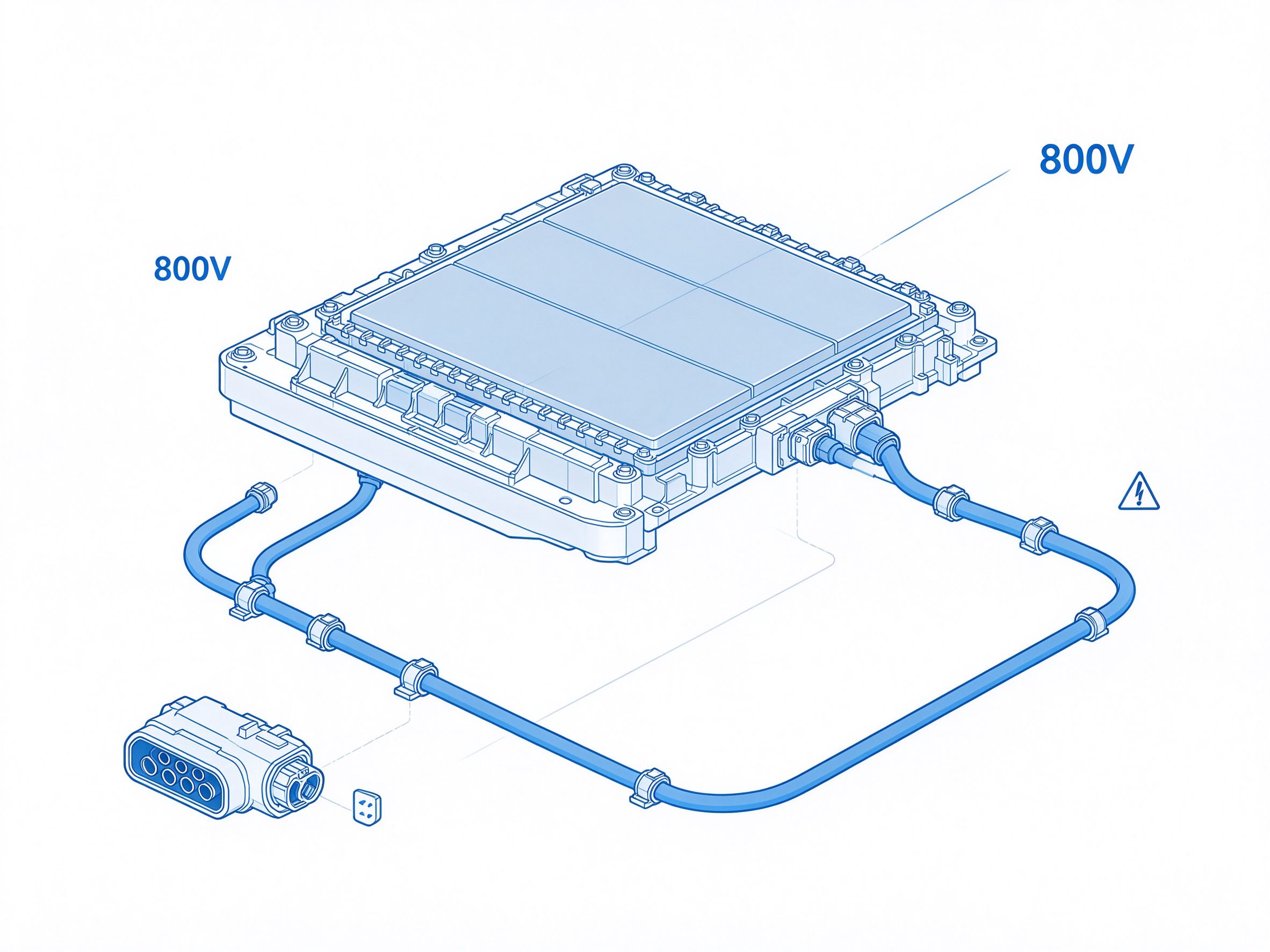
The High-Voltage Platform Sets New Harness Requirements
As the high-voltage platform spreads in new energy vehicles, new requirements are placed on harness voltage-withstand performance, shielding effectiveness and safety reliability. This article analyzes the specific challenges and solutions that the platform brings to harness technology.
The value of a high-voltage platform lies in improving vehicle energy transmission efficiency, and the harness, as the physical channel for high-voltage energy from battery to electric drive and from charging port to battery, has insulation, shielding and safety design that directly determine whether the platform solution can be implemented reliably. After the platform voltage rises, the current can drop at the same power, so the harness's current-carrying design and heat-control logic change accordingly, which also raises new topics for material selection and structural design of supply harnesses.
Three Major Technical Challenges from Platform Upgrade
Compared with the conventional 400V platform, the high-voltage platform doubles charging efficiency, and a 10-minute charge can deliver up to 400 km of range, but it also brings higher technical challenges: first, insulation and voltage-withstand requirements are higher, with DC withstand voltage reaching 1500 V or more; second, electromagnetic shielding requirements are stricter, as the strong electromagnetic interference from high-voltage harnesses may affect nearby low-voltage signal systems; third, safety protection requirements are higher, requiring integration of an HVIL high-voltage interlock loop.
On insulation and voltage withstand, the higher platform voltage raises requirements on the material and thickness of the wire insulation layer, and aging resistance under long-term operation also needs focused validation. On electromagnetic interference, high-voltage harnesses are among the stronger interference sources in the vehicle during charging and driving, sitting close to battery management signals and vehicle control signals; inadequate shielding design may cause signal abnormalities. On safety protection, the HVIL high-voltage interlock loop must respond quickly when a connector separates or a contact point is abnormal, cutting off the high-voltage circuit before personal injury occurs, which sets clear requirements on loop integration and connector selection.
From the vehicle layout perspective, high-voltage harnesses run along the chassis and around the battery pack through narrow spaces with many turning points, so bending radius and fixation method have clear requirements; at the same time, the vehicle is in vibration conditions long term, so contact reliability and fixation-point design must also be considered together at the solution stage.
Our New-Generation High-Voltage Harness Solution
To address these challenges, we have developed a new-generation high-voltage harness solution: it uses XLPE cross-linked polyethylene insulation with a temperature rating of 125°C; adopts a dual shielding design of aluminum foil plus braiding with shielding effectiveness no less than 90%; integrates an HVIL high-voltage interlock loop with response time no more than 100 ms; and uses dedicated high-voltage connectors whose protection rating meets high-voltage connection safety requirements.
The solution also makes systematic arrangements at the process-implementation level: high-voltage circuits and low-voltage signal circuits are routed in separate zones, and branch routing is fixed on jigs; the shielding layer stays continuous during crimping and assembly, and shielding continuity is confirmed in outgoing inspection; the HVIL loop is routed separately per drawings and included in the continuity test scope, ensuring the interlock function is delivered synchronously with the high-voltage main circuit.
Beyond materials and structure, assembly process also determines whether the solution lands: wire sequence is fixed on jigs per drawings, branches are gathered with tape or sleeving to reduce mutual friction between harnesses; after terminals are inserted into connectors, locking is confirmed in place, and the shielding layer stays continuous throughout assembly.
Test Validation and Quality Assurance
High-voltage platform upgrade is an important trend of new energy vehicle electrification, and the harness, as the backbone of high-voltage energy transmission, has safety design directly related to vehicle safety. We will keep improving the design, process and testing system for high-voltage harnesses to support customers' platform upgrades.
Tailored to high-voltage products, we run a complete quality-control process: incoming material inspection, in-process inspection of crimping and assembly, and outgoing final inspection. Wire insulation, crimp quality and shielding structure undergo voltage-withstand, insulation and shielding-effectiveness validation per drawings and technical agreements, and continuity testing is a mandatory outgoing item. System operation implements process control and batch traceability per requirements, inspection records are archived by batch, and can be provided directly during customer audits.
Before the project, failure mode and effects analysis identifies key risk points and forms corresponding inspection items; during mass production, quality is controlled through a combination of first article inspection and in-process patrol inspection, ensuring batch products match the confirmed sample.
FAQ
Q: What should high-voltage harness design focus on?
A: The focus is on insulation/voltage withstand, electromagnetic shielding and high-voltage safety: insulation material selection, high/low-voltage zoned routing, shielding continuity and HVIL loop integration must all be designed together with vehicle interfaces at the solution stage.
Q: How is the shielding structure of high-voltage harnesses validated?
A: The shielding layer stays continuous during assembly, and shielding-effectiveness tests are carried out per drawings and technical agreements; test records are archived by batch for traceability.
Q: How is the HVIL high-voltage interlock loop handled in the harness?
A: The interlock loop is routed separately per drawings and included in the outgoing continuity test scope, delivered and inspected synchronously with the high-voltage main circuit, ensuring contact status can be correctly recognized by the vehicle system.
Q: How does supply development start during a platform upgrade?
A: Providing platform drawings or technical agreements is enough to start evaluation; the engineering team gives solution recommendations from insulation, shielding and safety design perspectives, and the specific schedule is assessed per project and confirmed with our engineering team.
Contact Us
For high-voltage harness supply and technical exchange, please share your drawings or technical agreements, and our engineering team will reply with a proposal and sampling plan after evaluation. We are located at 7th Floor, Unit 2, Building E1-1, Qunyi Intelligent Manufacturing Industrial Park, No. 3 Xingyuan South Road, Start-up Area, China-Korea (Huizhou) Industrial Park, Zhongkai High-tech Zone, Huizhou; email sz136138@szfandouai.cn, phone 18929363263 (WhatsApp +86 18929363263).