
Pre-release sampling of appearance and label consistency: defect rejection, label-part match, packing protection and warehouse handover
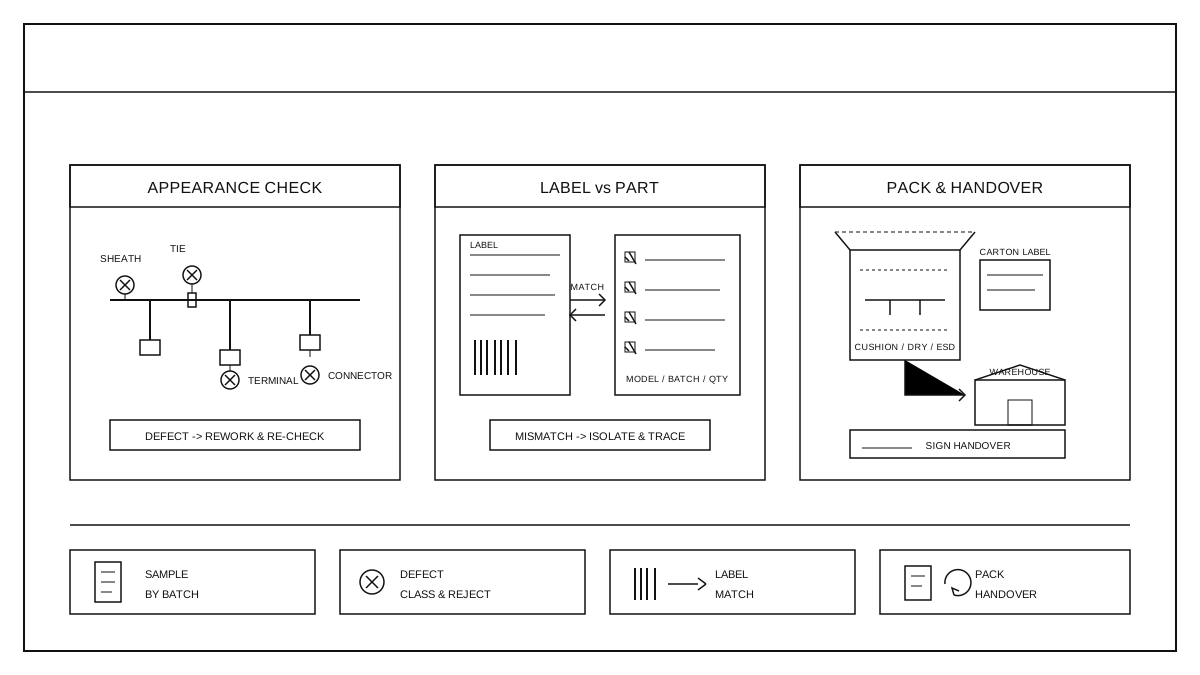
Inspection Targets and Sampling Methods
The inspection targets are harness products that have completed final assembly and electrical inspection and are awaiting packaging release. Sampling is organized by batch and packaging unit, rather than extrapolating the entire batch from a single item or workstation. The sampling items cover four categories: appearance, labeling, packaging, and quantity verification. The judgment criteria are executed according to the sampling plan and operation instructions, recording the work order number, product model, batch number, sampling unit, and inspector. Sampling is completed before the start of packaging operations. The harnesses selected for sampling remain in their original circulation state. Verification results and deviations are documented on-site, and only after confirming that there are no appearance or labeling abnormalities are the harnesses transferred to the packaging process. The sampling plan, sampling ratio, and judgment criteria are executed according to the document version, and must be reconfirmed after any process or packaging requirement changes.
Appearance Consistency Spot Check
Appearance inspection is based on drawings, process documents, and sealed sample parts, verifying each item for the harness surface, cable tie fixation method and position, terminal crimp appearance, connector insertion status, and branch routing. Defects are recorded according to appearance categories: sheath scratches, misalignment or missing sheath, cable ties not in the specified position or with leftover sharp ends, terminal crimp deformation, exposed copper, or skewing, connectors not fully inserted or clips not locked, and branch routing inconsistent with the drawings. If any critical appearance defect is found, the unit is judged as nonconforming, returned for rework and reinspection, and cannot be accepted as a concession. Harnesses that pass the appearance inspection can only proceed to the packaging stage after the inspector signs the circulation record.
Random inspection of label and physical item consistency
Label verification involves comparing the actual product with the label content item by item: checking whether the product model, material code, terminal layout, batch number, and quantity match the actual items to prevent material mixing. The readability of barcodes is checked by scanning each item with a scanning device to ensure successful recognition and that the material file it points to matches the actual item. Label position, adhesion, and clarity of writing are also included in the inspection. Labels with lifted edges, damage, misplacement, or missing information are deemed unqualified and should be re-labeled and re-inspected. The coding rules and system design of the label traceability system are not covered here; this article only deals with consistency sampling checks between labels and actual items before shipping. If mislabeling, missing labels, or unreadable barcodes are found, the packaging unit is immediately isolated and the source traced.
Packaging and warehousing verification
Verify that the cushioning, pressure prevention, moisture prevention, and anti-static measures are carried out according to the packaging operation instructions: cushions between the harness and the box walls are in place, moisture-proof and anti-static packaging is intact, and internal dividers prevent movement and abrasion during transportation. Check packaging labels and quantities against the packing list, ensuring that the product model, batch, quantity, and box number correspond one-to-one. Upon warehouse handover, both the warehouse and inspection personnel confirm the packaging condition, quantity, and labels, and the items are stored after signed handover; if damage, moisture, quantity discrepancies, or labeling errors are found, do not store immediately and return to the packaging process for handling, with abnormal batches clearly marked and isolated.
Recording and Closed Loop
The sampling inspection records include work order number, batch number, product model, sampling unit, classification and quantity of appearance defects, label verification results, barcode scanning results, packaging verification conclusions, as well as handling of abnormalities and reinspection status, forming a traceable record. Abnormal handling is carried out according to the non-conforming product process: isolation, rework, reinspection, and release or rejection, all leaving traces. Only after passing reinspection can the items be released into storage. Systemic issues discovered during sampling inspections are reported to the assembly and packaging processes; if necessary, work instructions are updated and sampling inspections are reorganized. For the overall process practices of appearance review before shipment, label verification, and packaging protection, see Pre-release appearance and label check, packaging protection, and warehouse handover.