
Re-inspection and release after rework: batch sampling, re-check scope, pass judgment, traceability and unapproved-item interception
Verification Object and Sampling Method
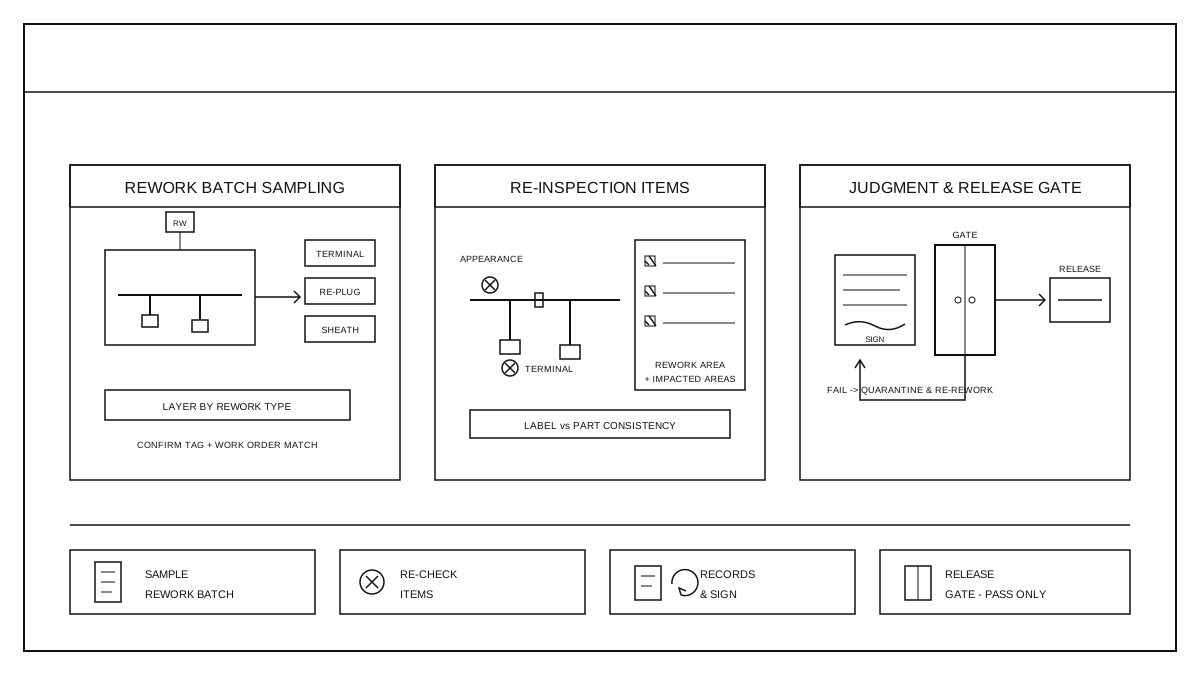
The objects for verification are harness batches that have completed repair work, are labeled with repair identification, and are waiting to re-enter the release sequence, rather than regular production batches. Sampling is organized based on repair batches as units, stratified according to repair types: different repair methods such as terminal replacement, re-termination, sheath repair, and tie management are sampled separately, without extrapolating a single repair item to the entire batch. Before re-inspection, confirm that the repair label, repair work order, and the actual item are consistent, ensure that the parts involved in the repair have been restored to a re-inspection-ready state, and remove temporary protections and repair aids. Sampling results, sampling units, and inspectors are recorded on site; if the repair method or repair scope changes, the sampling approach is reconfirmed, and conclusions from the previous repair batch are not carried over.
Re-test Projects and Determination Criteria
The re-inspection focuses on the parts that were repaired, while also checking whether the unrepaired parts were affected during the repair process. The items include appearance and assembly status, such as sheath routing, cable tie fastening, connector insertion, and latch locking; dimensions and terminal positions, such as branch locations, terminal orientations, and insertion relationships to ensure consistency with drawings and sampled standards; and label consistency with the actual item, such as label content, position, and barcode readability. The difference from the regular offline verification is that the re-inspection targets batches that have already been repaired, and when making judgments, the items described in the repair work order are verified simultaneously, without repeating the conventional electrical test methodology. If the repaired parts do not meet standards or the repair introduces new deviations, the unit is judged as failing the re-inspection and does not proceed to the release stage.
Determination and Release Conditions
Qualification judgments are carried out according to the hierarchical basis: first, the product status is determined based on drawings, process documents, and sealed samples; then, it is assessed whether the rework has been completed according to requirements using the rework work order and operation instructions. Only if both levels are met can the unit be judged as qualified on re-inspection. Acceptable units are confirmed by the inspector's signature on the re-inspection record; unacceptable units are handled according to the non-conforming product process and are not released as concessions. Records that must be complete before release include the rework work order, re-inspection record, sampling and judgment conclusions, abnormal handling status, and necessary approval points. Batches with incomplete records, missing approvals, or mismatches between the actual items and records are not released temporarily, and are only entered into storage or passed to the next process after completion and verification of consistency.
Recording and Traceability
The re-inspection record fields include the work order number, repair batch number, repair type, sampling unit, re-test item conclusions, judgment results, inspector, and date. The re-inspection records are linked to the repair work orders through the repair batch number, forming a traceable chain of offline anomalies, isolation, repair, re-inspection, release, or re-repair. Anomalous return refers to batches that fail the re-test being sent back to the isolation area for re-labeling; the boundary for re-repair is that the same defect can be repaired again, but the reason and measures must be stated in the work order, and the same repair cannot be done repeatedly without limit. Records are kept for traceability, and the design of the label coding system itself is not discussed in this document.
Closed Loop and Interface
The rollback path for batches failing reinspection is: return from the reinspection workstation to the isolation area, re-label and arrange repair according to the new repair type, and reinspect, without directly flowing to the next process. Batches passing reinspection are handled for outbound transfer from the isolation area and inbound transfer to the warehouse; during the transfer, verify that the repair label has been changed to a qualified release status, and that quantities and records match. To prevent unapproved items from entering the next process, a status gate is set between the reinspection workstation and the release workstation: only batches with complete approval are allowed to be stamped with a release mark and circulated; batches without a release mark are treated as in-process abnormal products, and the next workstation has the right to reject them. The overall process linkage of repair and reinspection can be found at After wiring harness offline, abnormal product isolation, rework, and revalidation: abnormal identification, isolation area management, rework boundaries, re-inspection and release.